
Sunday, November 14, 2010


A Small Lake and a Deer
I went for a drive yesterday. This is an old mining pit that's become a rather pretty, wildlife friendly lake.


And a White-tailed Deer


Did I mention it was cloudy and snowing a bit. Someday I will take pictures on a sunny day.

And a White-tailed Deer

Click on pictures to enlarge, if you want to.
Saturday, November 13, 2010
Eurasian Collared Doves (Part 1)
Well, I've been trying not to start posting about the doves. It was inevitable though since they are integral to my daily back yard birding, especially in Winter.
Yesterday afternoon, one of the white-buff ones, plus a few browns and dove-greys were all feeding just outside my window. Six of them clustered together for a little photo-op. I couldn't resist. I rather think this is a family group.
Eurasian Collared Doves Streptopelia decaocto

INTERESTING FACTS from whatbird.com
I will post many more photos and talk about this species much more over the next few weeks. Yes, they are invasive; however, I admire their ability to survive. These transplants from mild climates manage to cope with our harsh, extremely cold winters. They lose toes to frostbite in the process, but the population continues to increase. They are also very pretty and interesting birds.
Yesterday afternoon, one of the white-buff ones, plus a few browns and dove-greys were all feeding just outside my window. Six of them clustered together for a little photo-op. I couldn't resist. I rather think this is a family group.
Eurasian Collared Doves Streptopelia decaocto

INTERESTING FACTS from whatbird.com
- The Eurasian Collared-Dove is one of two species that have been argued to be the wild ancestor of the domestic Barbary Dove.
- Their scientific name, Streptopeleia decaocto, literally means a collar (streptos) dove (peleia). In Greek mythology, Decaocto was an overworked, underpaid servant girl. The gods heard her prayers for help and changed her into a dove so she could escape her misery. The dove’s call still echoes the mournful cries of her former life.
- Introduced into the Bahamas in the 1970s, some migrated to Florida in the 1980s. They went unnoticed at first because they look much like the Ringed Turtle-Dove. It wasn't until the mid-1980s that ornithologists realized the suddenly prolific and quickly spreading "turtle-doves" they were watching were actually Eurasian Collared-Doves. Their impact on native species is unknown; some have suggested that their spread represents exploitation of a niche made available by the extinction of the Passenger Pigeon.
- A group of doves has many collective nouns, including a "bevy", "cote", "dole", "dule", and "flight" of doves.
I will post many more photos and talk about this species much more over the next few weeks. Yes, they are invasive; however, I admire their ability to survive. These transplants from mild climates manage to cope with our harsh, extremely cold winters. They lose toes to frostbite in the process, but the population continues to increase. They are also very pretty and interesting birds.
Friday, November 12, 2010
Late Fall At My Place
My back yard over the past 5 days:
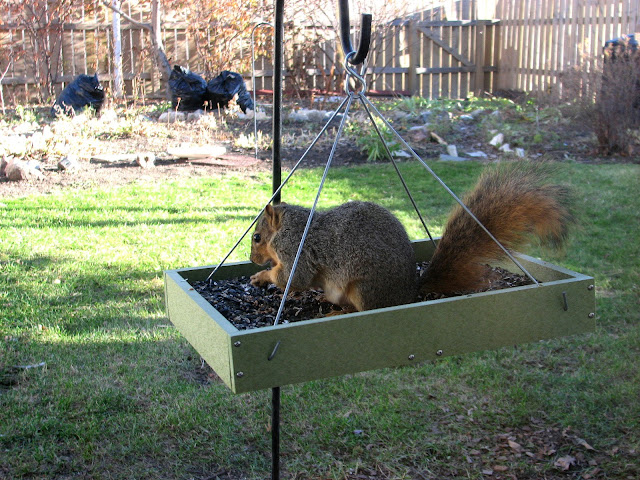
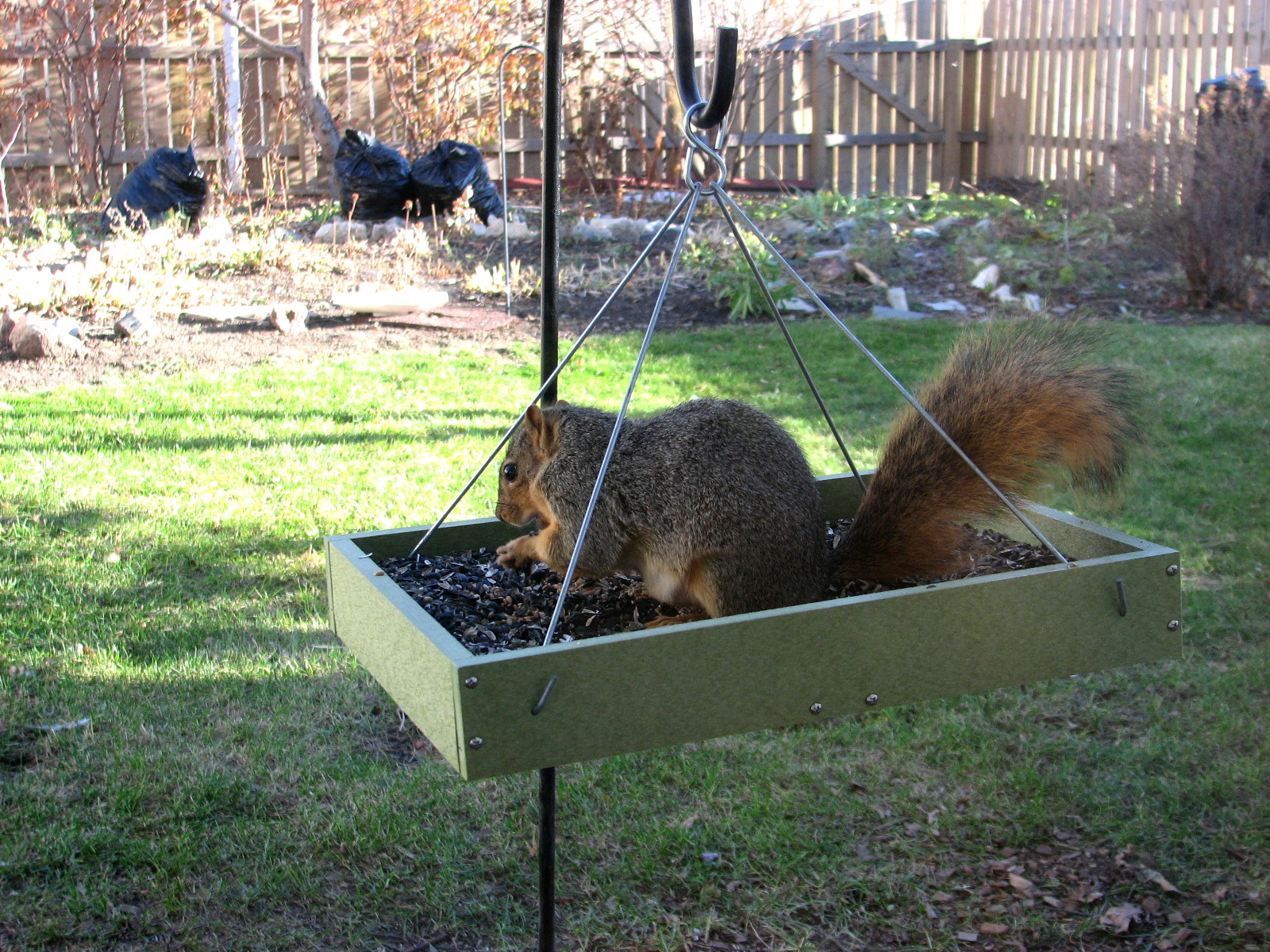
November 7/10, gratuitous squirrel picture
November 11/10, snow, pffft

November 12/10, a bit of melting going on this afternoon

November 7/10, gratuitous squirrel picture
November 11/10, snow, pffft

November 12/10, a bit of melting going on this afternoon

Personally, I'd like to see green grass again - like until, oh, about January 15th of some very distant year.
One Mourning Dove in the Snow
Mourning Dove Zenaida macroura


If so, it and its sibling live across the street in my neighbour Marian's spruce.

Ever since the little birds left the nest, they have come over to sit close to her when she works in her yard and garden.

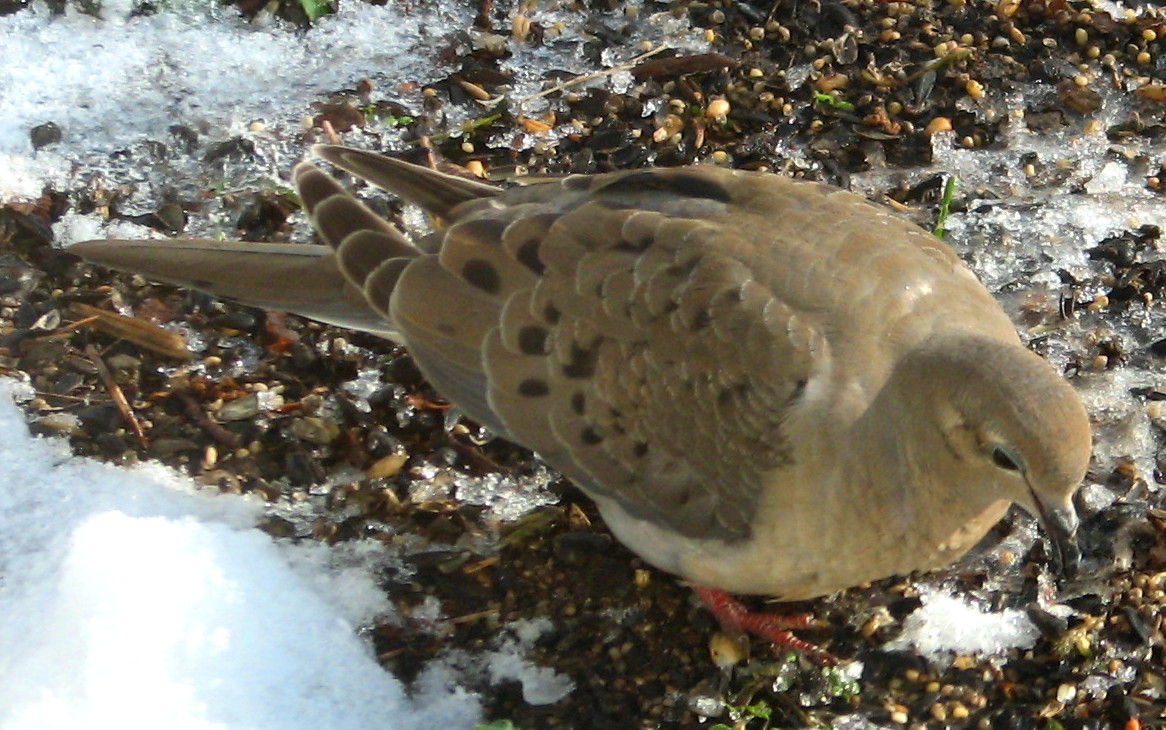
I think this is one of the doves that was too young to fly south when the rest of the Mourning Doves left, about a month ago.

If so, it and its sibling live across the street in my neighbour Marian's spruce.

Ever since the little birds left the nest, they have come over to sit close to her when she works in her yard and garden.

Thursday, November 11, 2010
Blue Jay - Again
Blue Jay Cyanocitta cristata

Cool Facts from All About Birds
- Thousands of Blue Jays migrate in flocks along the Great Lakes and Atlantic coasts, but much about their migration remains a mystery. Some are present throughout winter in all parts of their range. Young jays may be more likely to migrate than adults, but many adults also migrate. Some individual jays migrate south one year, stay north the next winter, and then migrate south again the next year. No one has worked out why they migrate when they do.
- Blue Jays are known to take and eat eggs and nestlings of other birds, but we don’t know how common this is. In an extensive study of Blue Jay feeding habits, only 1% of jays had evidence of eggs or birds in their stomachs. Most of their diet was composed of insects and nuts.
- The Blue Jay frequently mimics the calls of hawks, especially the Red-shouldered Hawk. These calls may provide information to other jays that a hawk is around, or may be used to deceive other species into believing a hawk is present.
- Tool use has never been reported for wild Blue Jays, but captive Blue Jays used strips of newspaper to rake in food pellets from outside their cages.
- Blue Jays lower their crests when they are feeding peacefully with family and flock members or tending to nestlings.
- At feeders in Florida, Red-headed Woodpeckers, Florida Scrub-Jays, Common Grackles, and gray squirrels strongly dominate Blue Jays, often preventing them from obtaining food.
- The pigment in Blue Jay feathers is melanin, which is brown. The blue color is caused by scattering light through modified cells on the surface of the feather barbs.
- The black bridle across the face, nape, and throat varies extensively and may help Blue Jays recognize one another.
- The oldest known wild, banded Blue Jay lived to be at least 17 years 6 months old.
Wednesday, November 10, 2010
Pine Siskins
Pine Siskins Carduelis pinus

As you can see, we got some snow - not much, and the sun is trying to shine through the clouds. C'mon, Sun! Freezing rain overnight is likely making things pretty exciting out on the roads. However, I don't have anywhere I need to be, so I'm sitting here in my sun room watching the Pine Siskins.
This is another boreal nester that comes South for the Winter. These little birds especially love thistle (niger) seeds.

Tuesday, November 9, 2010
A Simple Cup of Tea
This is my favourite tea cup.

It was made by a young potter named Shane, from the white mud/clay of the Frenchman River Valley

and bought at a pottery studio in Eastend, Saskatchewan.

which is home of Scotty and The T.rex Discovery Centre

and current home of Sharon Butala, writer, environmentalist, an Officer of The Order Of Canada and recipient of the Saskatchewan Order of Merit

Eastend has another literary connection: Wallace Stegner, 1972 winner of the Pulitzer Prize for fiction, who lived there for a few years during his childhood. Stegner wrote about his youth in Eastend in his autobiography, Wolf Willow. The house he lived in has been restored by the local arts council and serves as residence for writers and artists.


It was made by a young potter named Shane, from the white mud/clay of the Frenchman River Valley

photo by David McLennan
and bought at a pottery studio in Eastend, Saskatchewan.

which is home of Scotty and The T.rex Discovery Centre

and current home of Sharon Butala, writer, environmentalist, an Officer of The Order Of Canada and recipient of the Saskatchewan Order of Merit

Image by Duane Prentice
Eastend has another literary connection: Wallace Stegner, 1972 winner of the Pulitzer Prize for fiction, who lived there for a few years during his childhood. Stegner wrote about his youth in Eastend in his autobiography, Wolf Willow. The house he lived in has been restored by the local arts council and serves as residence for writers and artists.

The above photo is by writer and photographer Jerome Martin who shares his own Eastend experience here
ding. ding. ding. ding. ding. Tea Break is over.
Extremely Thin Galaxy

Credit: ESA, Hubble, NASA
Explanation: Why is there a line segment on the sky? In one of the more precise alignments known in the universe, what is pictured above is actually a disk galaxy being seen almost perfectly edge on. The image from the Hubble Space Telescope is a spectacular visual reminder of just how thin disk galaxies can be. NGC 4452, a galaxy in the nearby Virgo Cluster of Galaxies, is so thin that it is actually difficult to determine what type of disk galaxy it is. Its lack of a visible dust lane indicates that it is a low-dust lenticular galaxy, although it is still possible that a view from on top would reveal spiral structure. The unusual stellar line segment spans about 35,000 light years from end to end. Near NGC 4452's center is a slight bulge of stars, while hundreds of background galaxies are visible far in the distance. Galaxies that appear this thin are rare mostly because our Earth must reside (nearly) in the extrapolated planes of their thin galactic disks. Galaxies that actually are this thin are relatively common -- for example our own Milky Way Galaxy is thought to be about this thinFrom Astronomy Picture of the Day
Subscribe to:
Posts (Atom)