Monday, May 14, 2012

Wild Turkeys

I forgot about the Wild Turkeys (Meleagris gallopavo) I saw in North Dakota a couple weeks ago.  I didn't get stopped and camera grabbed soon enough to get a photo of a male all puffed out in the ole Thanksgiving Turkey display.  Too bad, he was gorgeous.

I heard him gobble, though.


A cool fact from AllAboutBirds:

A native of North America, the turkey is one of only two domesticated birds originating in the New World. The Muscovy Duck is the other.

I'm hungry (just kidding....but who doesn't love a good roast turkey dinner?)

Go here to listen to gobbles:


Sunday, May 13, 2012

Spring Birding

I had a fantastic day yesterday driving around my area, checking out the sloughs - the old sloughs are filled with reeds and cattails.  Always great for wading birds.  We had so much rain last year (flooding) that all low-lying areas in cultivated fields are also filled with water...and these shallow water bodies with muddy shores are prime for shorebirds.

Pectoral Sandpipers (Calidris melanotos ) below are fairly numerous at the moment. 


 Of course, there are plenty of muskrats busily swimming back and forth in their particular water spaces.  I think they are so cute.


 A rear view of a pair of Northern Shovelers (Anas Clypeata).  Cool Facts from AllAboutBirds:

The bill of the Northern Shoveler is about 6.5 cm (2.5 inches) long. The bill has has about 110 fine projections (called lamellae) along the edges, for straining food from water

Northern Shoveler pairs are monogamous, and remain together longer than pairs of other dabbling duck species. 

When flushed off the nest, a female Northern Shoveler often defecates on its eggs, apparently to deter predators.


 This is a favourite slough.  The shoreline is usually filled with resting ducks, squabbling Canada Geese, long-legged American Avocets and every other species of shorebird that happens to be around.  But not yesterday morning when I came by.  Mr. or Mrs. Coyote had got there first.


 And here's a Willet (Tringa semipalmata).  Willets are just one of those birds that is here all summer.  Nondescript really, except when flying.  A distinctive call that anyone who has spent time in the prairies in summer will recognize.  No Big Deal.   Yet, a couple years ago, I was birding at a fairly well-known area.  Some other birders were present (from the East) and were so over-joyed to be seeing Willets.


And this is probably why (from AllAboutBirds):

Willets and other shorebirds were once a popular food. In 1871, John James Audubon wrote that the eggs were tasty and the young “grow rapidly, become fat and juicy, and by the time they are able to fly, afford excellent food.” By the early 1900s, Willets had almost vanished north of Virginia. The Migratory Bird Treaty Act of 1918 banned market hunting and marked the start of the Willet’s comeback.

Another Willet fact:  Although both parents incubate the eggs, only the male Willet spends the night on the nest.


There are two distinct subspecies of Willets.  The Western  (T.s. inornata) and the Eastern  (T.s. semiplamata)

For more info, go to:

http://www.allaboutbirds.org/guide/Pectoral_Sandpiper/lifehistory
http://www.allaboutbirds.org/guide/Northern_Shoveler/id
http://www.allaboutbirds.org/guide/willet/id 


Wednesday, May 9, 2012

Rose-breasted Grosbeak

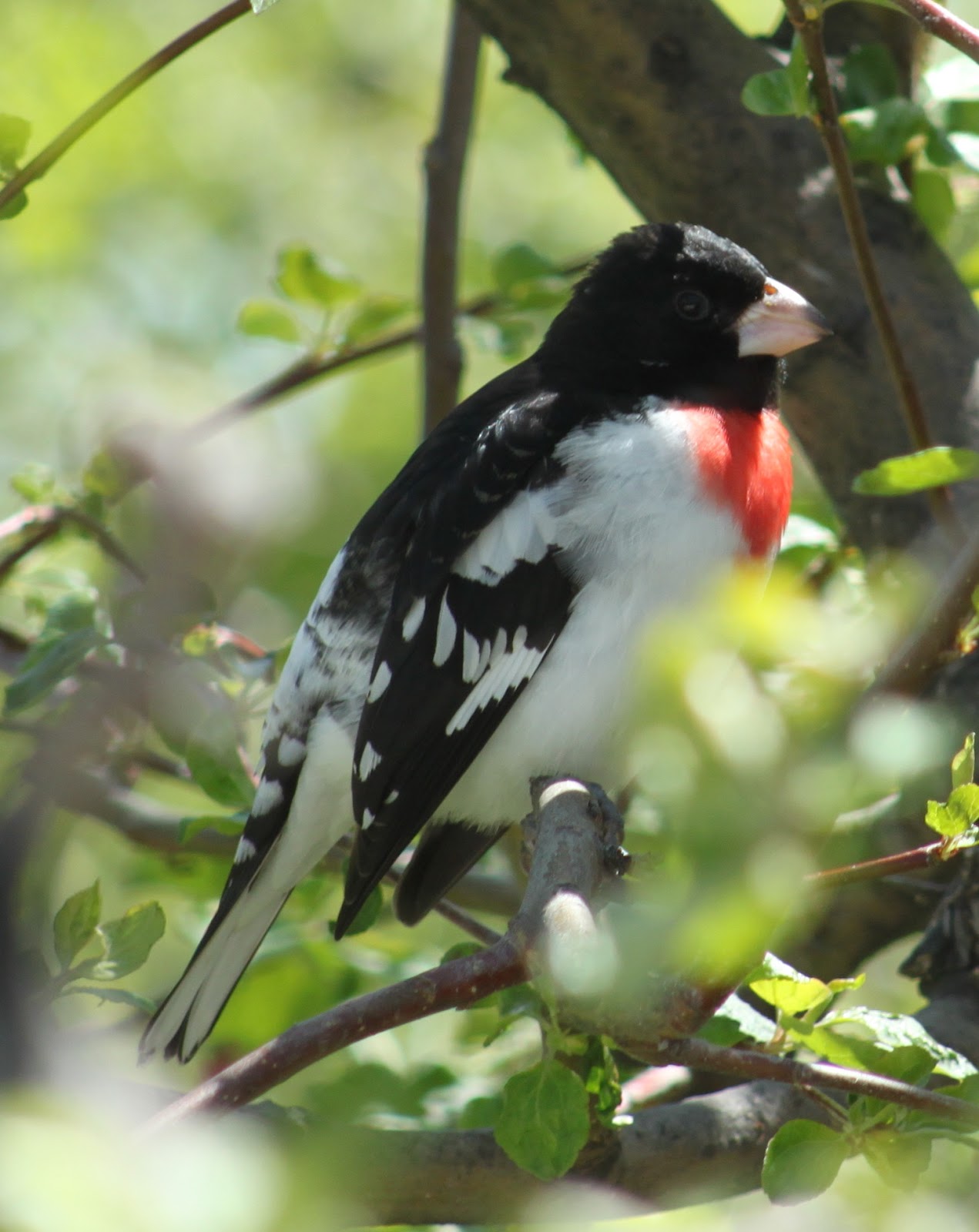
Yesterday, one of my favourite birds showed up in my yard and stayed around the feeders in the apples trees pretty well all day.


This is a male Rose-breasted Grosbeak (Pheucticus ludovicianus); females of the species are not very colourful, tending towards dull browns, beige and white.  They have a prominent eyebrow, or supercilium, and look quite like female Purple Finches, except bigger.  There were no lady grosbeaks around.

That's too bad, because this is one handsome dude.

Rose-breasted Grosbeaks are members of the Cardinal Family (Cardinalidae). 

For more information:
http://www.allaboutbirds.org/guide/Rose-breasted_Grosbeak/id


Monday, May 7, 2012

White-throated Sparrow

This little fellow slammed into a bedroom window early this morning.  The bird was completely stunned, so I held him for awhile in cupped hands; its eyes were alert and bright.

I set it on a seed-catcher tray to recover.


We Canadians love the return of White-throated Sparrows (Zonotrichia albicollis) in the Spring .... as we interpret their song as  "O Sweet Canada, Canada, Canada"


Little one sat in the tray for about 20 minutes.


Later, when I went out to check, it hopped down to the ground to hide in some shrubs.


I have to paint or tape some stripes on that window.  There's an apple tree just a few feet away and the glass reflects the foliage. 

For info about White-throated Sparrows, go to:

http://www.allaboutbirds.org/guide/White-throated_Sparrow/lifehistory


Saturday, May 5, 2012

At Sakakawea State Park

I went on my Spring shake-down rving trip this week.  Ended up at Sakakawea State Park (at the west end of Garrison Dam) in North Dakota.  

A light rain shower one evening presented a couple of beautiful photo ops.

The lake was glassy calm, perfect for mirroring a little rainbow on the Rivercity side.


 Two White-tailed Deer stopped for a moment on their trek down to the water


Monday, April 30, 2012

The Very Large Array

A couple months ago when I was on my way to Tucson, I stopped overnight at Socorro, New Mexico.  Some 50 miles/80 kms. northwest of there, along Hwy 60, is the Very Large Array....


of radio telescopes, that is.


Dedicated in 1980, the Very Large Array (VLA) has been an extraordinarily productive scientific instrument. Astronomers from around the world use it to study objects from our Solar System to the edges of the known Universe, billions of light-years from the Earth.


The telescope array consists of twenty-seven, 230-ton, 25-meter diameter dish antennas.  The data from the antennas is combined electronically to give the resolution of an antenna 36km (22 miles) across, with the sensitivity of a dish 130 meters (422 feet) in diameter. For more information, see our overview of the VLA. The array is currently in the D configuration.


The VLA has made key observations of black holes and protoplanetary disks around young stars, discovered magnetic filaments and traced complex gas motions at the Milky Way's center, probed the Universe's cosmological parameters, and provided new knowledge about the physical mechanisms that produce radio emission.


The VLA is now being transformed into a new research instrument: the Expanded Very Large Array (EVLA). By 2012, new state-of-the-art electronics and software will have completely transformed the VLA into the EVLA, a much more capable research tool with more than ten times the VLA's sensitivity. Reinvigorated by new technologies, the EVLA will push the frontiers of science and knowledge for decades to come.


The VLA is located on the Plains of San Agustin, the site chosen because of the isolated location away from large population centers, and the partial shielding effect of the surrounding mountain ranges.

Geologically, the Plains of San Agustin lie within the Mogollon-Datil volcanic field, just south of the southeast edge of the Colorado Plateau, and west of the Rio Grande Rift Valley. The basin is a graben (a downdropped block which subsided between parallel faults). The graben is younger than the Datil-Mogollon volcanic eruptions. The flat floor of the plains was created by a Pleistocene lake (Lake San Agustin). Although the graben has dropped an estimated 4,000 ft., the surface relief has been reduced to about 2,000 ft. by sedimentation. A great deal of the sediments entered the San Agustin basin prior to the formation of Lake San Agustin in the last glacial period. There is no evidence of tectonic activity in the area after Lake San Agustin became extinct.

The edges of the plains have sites of archaeological interest such as a prehistoric rockshelter known as Bat Cave.

Other sites in the area include a ghost town called Old Horse Springs and the Ake Site, a prehistoric occupation site. 


And, wow, was it ever windy the morning I visited the VLA and drove through the Plains of San Agustin!  Too windy (and cold) to do the walking tour at the VLA - another time.....I will return. 


No, the VLA is not involved in SETI, or the Search for Extraterrestrial Intelligence.  But, at least one UFO researcher believes the Plains of San Agustin was a site of a UFO crash in 1974, but then this IS New Mexico and everything in southern New Mexico seems to be space-related.  I love it.


I lifted all of the above information directly from some of the websites listed below:

Official site of the VLA:

Wikipedia


Monday, April 23, 2012

White-tailed Deer

A birding drive yesterday produced a lot of new birds - shorebirds are starting to show up.  I found some Semipalmated Sandpipers, Lesser Yellowlegs and a good number of Marbled Godwit pairs.  I don't have a good photo of any.  

On days such as yesterday, I'm pretty much birder-only, remembering to grab the camera only after I've gazed long through the binoculars or scope.

Several White-tailed Deer (Odocoileus virginianus) were grazing near sloughs in the early morning.  I managed to capture one with tail-flag waving.


These American Coots (Fulica americana) were intent on their mating rituals.  A lot of preening and stamping of the reed platform by the male.  Coots are amazingly interesting to watch.  


American Avocets (Recurvirostra americana) have been arriving in the area the past week, which was really cold, rainy and windy.  I expect by tomorrow (after two days of very warm, sunny weather) the shorelines will be much alive with these elegant creatures.


Friday, April 13, 2012

Arizona & New Mexico Guide Books

Before I forget, and as I get things put away and tidied up from my trip down to Arizona, I want to share a few great guide books. 

This latest edition of the Tucson Audubon publication, Finding Birds in Southeast Arizona, is an invaluable asset for the travelling birder. 


It gives a lot of trip planning advice, including some tips about visiting Mexico.  The book is set out in areas.  For example, Chapter 1 is Urban Tucson, giving explicit directions how to get to all birding areas within the city and birds you might expect to see (given the season).  I visited a good many of the areas outlined in Chapter 8, Huachuca and Whitestone Mountains, and the Upper San Pedro River Valley. 

Get this book before you go to Southeastern Arizona, period!  There are 372 pages of info, including adverts for various B&Bs and birder-friendly businesses.

Ditto this one, from Richard Taylor, published by American Birding Association, Inc.
  

Taylor compiles information in terms of destination areas; he supplies maps with trails well marked (in some cases, there are tear-out maps in the back so you don't have to take the entire book on long hikes).  

There is some information overlap with these two books, but each adds to the magnificent birding experience of SE Arizona. 

Both books are available on-line at:
http://www.tucsonaudubon.org/nature-shops.html

As with the above Arizona books, this one for New Mexico is a must. 


 I picked this up several years ago.  It is available from the New Mexico Ornithological Society on-line.  It is laid out in counties, shows maps of each county with the parks/locations.  Location write-ups includes an extensive list of birds likely to be found and when.  At 351 pages including index, there is a lot of info in this book.

Here are two Birding Trail maps that really help the visiting birder plan the trip.  Definitely get them before travelling. 


This National Audubon field guide is simply the best for the all-round, very curious travelling nature-lover.


It generally explains the area geology, has a section on rocks, mosses & lichens, plants (shrubs, trees, cacti, flowers), and features the common birds, insects, reptiles, mammals of the region.  There are even some star maps for those nights outside marvelling at the magnificent starry sky.  It is nicely sized to go along in a pocket or backpack.

All of these books are available at the various park gift shops as well.

Tuesday, April 10, 2012

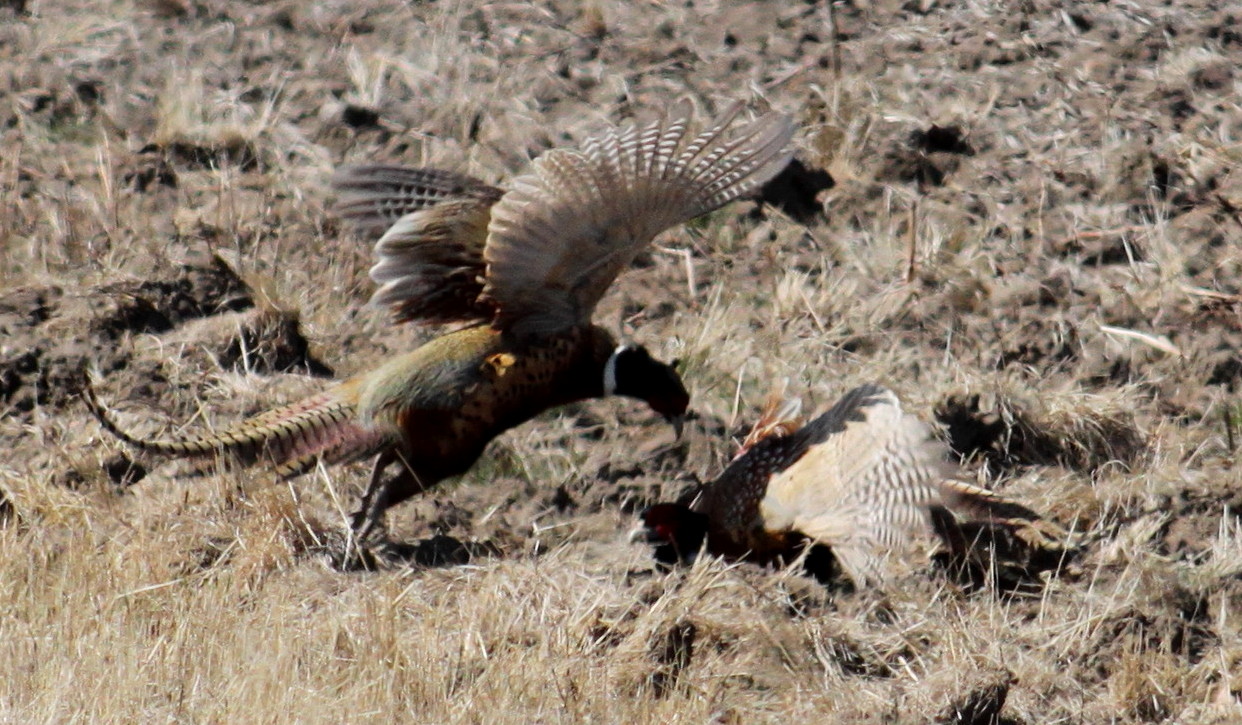
Cock (Pheasant) Fight!

Today, along a road I was slowly driving; looks like a younger fella (on right) decided to take on a handsome older chap.


That's the older one in the air


The older one on left


And the older fella attacking.


Ring-necked Pheasant  Phasianus colchicus

Monday, April 2, 2012

Pyrrhuloxia

The Pyrrhuloxia (Cardinalis sinuatus)  is a relative of the more widely-known Northern Cardinal.  A couple of local names are Desert Cardinal and Silver Cardinal.  This is a bird of the scrub deserts of Mexico, western Texas, and the southern parts of Arizona and New Mexico.


The male Pyrrhuloxia look quite a lot like the female Northern Cardinal, but with more rosy red in the face and chest and different beak shape.  The Pyrrhuloxia beak is quite parrot-like.  These close relatives sound much alike, with the Pyrrhuloxia's song being a little higher pitched and clipped. 


These particular photos were taken at San Pedro House in mid-March.  This male is rather dull, not yet having his bright Spring/Summer breeding colours. 

Its name of Pyrrhuloxia - once part of its latin name - comes from Greek terms describing its coloration (πυρρος = pyrrhos = reddish or orange) and the shape of its bill (λοξος = loxos = oblique). (obviously from Wikipedia


These birds prefer scrub desert but also close to water.  The riparian habitat along the San Pedro is ideal.  They are pretty much non-migratory, however in Winter some may wander outside their usual range.  That usual range is also expanding northward, benefitting from agricultural and other human influences (now that's something one doesn't hear very often!).   Visit Wikipedia or All About Birds (links below) or check out your North American bird guide books for range and more about these birds.


The above bird was at San Pedro as well, but along the river.  I found Pyrrhuloxias everywhere I visited in SE Arizona.  They readily come to seed feeders.  Their wild diet is seeds, fruits and insects. 

For more info about this bird species, hear the bird song, etc, visit:

http://www.allaboutbirds.org/guide/pyrrhuloxia/id
http://www.allaboutbirds.org/guide/pyrrhuloxia/lifehistory
http://en.wikipedia.org/wiki/Pyrrhuloxia