Sunday, April 14, 2013

Ferruginous Hawk

Most birders have a favourite raptor.  Mine is the Ferruginous Hawk (Buteo regalis).
This is a hawk of my beloved wide-open prairies.  Pete Dunne calls it Russet-backed Prairie Eagle.  


The sexes are similar.  This bird is a 'light morph'.  Notice the rusty shoulder patches, white underparts, light coloured head, pale tail.  The gape (or the lips, if you will) is extended and yellow - gives the bird a smiley look.

 
A couple of Cool Facts from All About Birds:

-  Before the elimination of bison in the West, nests of the Ferruginous Hawk were often partially constructed of bison bones and wool


- The Rough-legged Hawk, the Ferruginous Hawk and the Golden Eagle are the only North American hawks to have legs feathered all the way to the toes.

Ferruginous means rusty-coloured.  Note the rusty markings and also long, pointed wings and the white base of the primaries.


Not long ago, Ferruginous Hawks were considered pests by farmers & ranchers (and honestly, what wasn't?).  So, they were shot and poisoned (again, what wasn't, or isn't?).  But, then it was realized that the hawks primarily fed on ground squirrels and pocket gophers which farmers & ranchers find to be even greater pests.  So nowadays, these lovely great hawks are considered 'friendly'.  It might take a little while for the reactive farmers & ranchers to a) stop poisoning the ground squirrels and b) cultivating the ever dwindling open prairie so necessary for my beautiful hawks to survive.  Note:  I grew up on a farm here on the southern Saskatchewan prairie.

This species is considered threatened in Canada.  

I am lucky to live where there is still a bit of natural prairie left (not much and the community pastures are being sold off, remaining private pastures are being cultivated and seeded to grazing hay). Several pairs of FEHAs return to this area yearly, reusing their nests.

Range Map below.

Ferruginous Hawk Range Map

All About Birds
Pete Dunne's Essential Field Guide Companion
Birds of Canada

Wednesday, April 10, 2013

Common Redpolls - Smart Birds

I have a lack of redpolls!  The past couple of days, the 100+ Common Redpolls (Carduelis flammea) that wintered in my neighbourhood have gone. There are only 2-3 around my yard now.

Actually with this never-ending Winter of 2013, they have lingered here longer than usual, giving us nice looks at the very bright rosy-red breeding plumage.

 
Pete Dunne calls them the Catkin Finch and says this northern finch loves birch catkins - simply loves them.  I don't have birch.  I toss out seeds in the winter.  That works, too.


Quoting P. Dunne once again, he describes the CORE as a "streaky, stubby, effervescent pip-squeak of a finch with a small red beret and a black goatee."

These birds are smaller than House Finches.  They are a little bigger than a Pine Siskin, with which the less showy female redpoll can be confused (until one sees the jaunty red cap).
 
 
These personable little birds are arctic and subarctic breeders.  All About Birds provides us with this little cool fact:
Common Redpolls can survive temperatures of –65 degrees Fahrenheit. A study in Alaska found redpolls put on about 31% more plumage by weight in November than they did in July.   During winter, some Common Redpolls tunnel into the snow to stay warm during the night. Tunnels may be more than a foot long and 4 inches under the insulating snow.
I’ve never seen evidence of this, but then we don’t get quite as cold as –65F....close but not quite....at that temp, I’d probably be a little busy tunnelling into the snow myself to notice what birds are digging along side of me. 


Another fun fact:   Animals behaviourists commonly test an animal’s intelligence by seeing if it can pull in a string to get at a hanging piece of food. (I’m not making this up). Common Redpolls pass this test with no trouble. They’ve also been seen shaking the seeds out of birch catkins, then dropping to the ground to pick them up from the snow surface.

And: Redpolls have throat pouches for temporarily storing seeds. They may fill their pouches with seeds quickly then fly away to swallow the seeds in a more protected, warmer spot.

 
The fun facts with these birds never end.....here's yet another one:
Redpolls breed in all the the lands that ring the Arctic Ocean. A few banding records have shown that some Common Redpolls are incredibly wide ranging. Among them, a bird banded in Michigan was recovered in Siberia; others in Alaska have been recovered in the eastern US, and a redpoll banded in Belgium was found two years later in China.


Info sources:

All About Birds
Pete Dunne's Essential Field Guide Companion 

Sunday, April 7, 2013

American Tree Sparrow

Or, as Pete Dunne calls it, The Winter Chippy.  

The American Tree Sparrow (Spizella arborea) is one of the first sparrows to arrive in my area in the Spring and the last to leave in the Fall.  It winters in southernmost Canada and all over the US.  It breeds in the arctic so doesn't mind a bit of late Spring snow on the trip north.

Three arrived in my back yard this past Monday.  Snow still piled up but a few days of melting have exposed the layers of birdseed I've been tossing around during the past few months of snowdom. 

 
Contrary to the name, this sparrow is found mostly in shrubby areas, weedy fields, edges of marshes, etc.  It nests in stunted willows and spruce in boggy or open areas of the northern tundra.  

This sparrow feeds on the ground in rapid shuffling movements; it will also leap up to grab seeds from tall grasses as well as foraging high in trees, quite liking birch catkins.


The ATSP is a medium-sized, plump sparrow with a small bi-coloured bill - dark upper, yellowish lower - with a richly patterned back and a long tail.
  
It is sometimes confused with Chipping Sparrows as both have rufous crowns and an eye stripe.  However, the ATSP has a rusty brown eye stripe with gray above and below.  The CHSP has a black eye stripe and a white eyebrow.

The Am. Tree Sparrow has a dark breast spot on an unmarked chest.

Information sources:
Pete Dunne's Essential Field Guide Companion

All About Birds


Sunday, March 31, 2013

Another Souris River Report

I'm starting to get Spring Fever.  The days are getting longer, the sun is higher in the sky and even if the air isn't particularly warm, the snow melts a little bit each day.  That said, there's still a solid 2-3 feet of the stuff all over my back yard.

So, this morning I grabbed my binoculars and camera and went for another drive, hoping to find some birds.  No birds, so I went out to Rafferty to see how the water release is going.


There has been some melting in the past couple of days; also an increase in the flow out of Rafferty. 

 
This is the Souris River south of Estevan along #18.  The water has breached the banks in low areas here too.  Nothing serious.

 
Ah, there are some birds.  Canada Geese and Mallards near the bank.  The goose in the middle of the stream is a Cackling Goose (Branta hutchinsii)

 
At the Woodlawn Park bridge on #47

 
This is the low bridge at Vaugn's Crossing (east side of Woodlawn).  The water is pretty close to the bottom of the bridge.


Hopefully, this early release of water from Rafferty will prevent serious flooding as the Spring melt gets underway.  Surely this stuff WILL melt!


Friday, March 29, 2013

The Draining of Rafferty Reservoir

Or at least a partial drain of this vast reservoir on the Souris River....in prep for Spring run-off.


There is an enormous amount of snow this year


Thursday, March 28, 2013

Impatiently Waiting for Spring

I went for a drive yesterday afternoon - the first drive-about I've done in a long time.  There's too much snow, plain and simple.  The roads are icy, the ditches are level-full of snow and it is still very, very cold here.  No, I can't seem to stop grumbling about this never-ending Winter.

Anyway...in spite of the vast snow cover, it IS the time of year when the first migrants start showing up.   As well, I wanted to check on the Souris River.  Water has been released from Rafferty and Boundary all winter.

This is the river south of Shand Power Plant.  The water level is very high - this area was all under-water two Springs ago.

 
First of all, there are small herds of deer grazing for whatever poor quality grass is left to nibble.  These are White-tailed Deer (Odocoileus virginianus)

 
And their sentinel.


What is this big ol' woolly-looking bundle trundling along the rim of Boundary reservoir?


Mr. or Mrs. Yellowquill, I believe.  The North American Porcupine (Erethizon dorsatum) My trusty Kaufman Field Guide to Mammals of North America informs that this is our second-largest rodent and that it's sharp quills are actually modified hairs.


And then there were the tree-top grouse.  To me, there are some birds which just do not suit being at the top of a very tall tree among the more spindly branches.  (Cormorants are undoubtedly the silliest.)  A plump Sharp-tailed Grouse (Tympanuchus phasianellus) at the top of a poplar looks rather awkward, or something. 


I guess the view is better; the buds probably taste about the same as the lower ones.

When I was driving back out of the little park at Boundary, I saw something sort of moving up ahead on the road.  I slowed...really?  Is that a...???


Yes, a young Richardson's Ground Squirrel (Spermophilus richardsonii), most affectionately known simply as 'gopher'.  It was only partly alert to its surroundings, probably not entirely awake from hibernation...and I could have picked it up easily enough.  (I didn't).  

 
I have no idea where it came from, as there were no bare spots of ground showing along the road or ditches for some distance.  Poor little buddy; I hope it found its way back to its home.

This is the Souris River at Woodlawn bridge.  The resident Canada Geese (Branta canadensis)  have been enjoying the open water on the river; some appear to be pairing off.  Also in the picture are three pairs of Northern Shovelers (Anas clypeata).  They are Spring arrivals.

Many signs of Spring out there.  Now, if this snow would melt....except that's bound to bring a lot of flooding.  It's going to be one of those years.


Wednesday, February 6, 2013

Smith's Longspur

This is my Lifer Smith's Longspur (Calcarius pictus) found at Last Mountain Lake in south-central Saskatchewan late September, 2012. 


This one plus two others were flitting around the cut and baled hay; two flew off and this male decided to hide in the shade of a large, round bale.  It was a hot day.  I don't blame him one bit....except it didn't give me much of a chance for getting a good photo.  Ah well....

Smith's Longspurs were one of the species I hoped to see around Churchill, MB (June), but we failed to find any.  Smith's Longspurs, along with its more common relative, the Lapland Longspur, is a tundra-breeder.  Smith's migrate to the south-eastern prairies of the US (E. Oklahoma, Texas, etc) to hang out in short grass prairie, mowed hay fields near water.  A habitat that perfectly describes where I saw them in here in SK.


Pete Dunn calls this The Tawny Longspur.  A good description, as my bird had a distinctly tawny breast  and generally overall, even though not in breeding plumage. 


References:
 
Pete Dunn's Essential Field Guide Companion 

All About Birds


Sunday, February 3, 2013

Wildflowers And Turkeys

Last June, after my Churchill trip, I spent a day driving around the woods and marshes east of Winnipeg.  I love marshes and fens. 


 The Blue Flag Irises (Iris versicolor) were blooming (irises are my favourite garden flower) 

  
There are bugs on these flowers, wonder what they are.


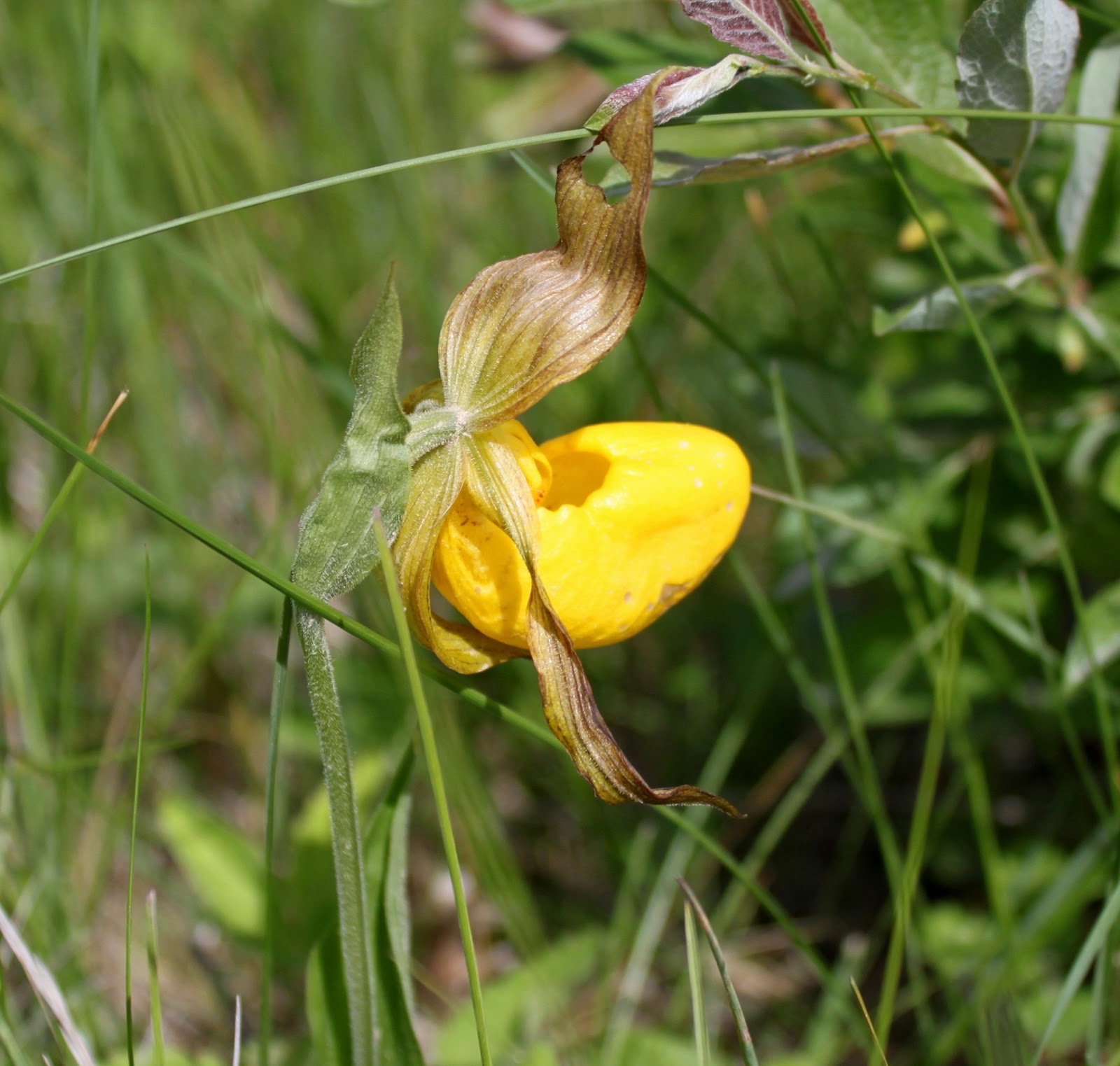
 A Large Yellow Lady`s Slipper  (Cypripedium pubescens var. pubescens).  Another wild flower I am always delighted to find.


Some Yellow Pond-lily (Nuphar variegatum) pads with a flower bud


Two Wild Turkey (Meleagris gallopavo) toms....who were displaying and putting on a bit of a performance, until we got close.  I never have the `right` lens on my DSLR.


Oh well, it is always fun to see these big, rather ugly-yet-handsome birds.


Monday, January 14, 2013

Beautiful Sunrise

I've got to get back into regular blogging.....so to ease my way into 2013 activity, here's a sunrise from last Thursday - just before a snow storm swept through the area.


Tuesday, December 25, 2012

Merry Christmas & Happy Holidays

Season's Greetings


Rose-breasted Nuthatches are busy feeding at the feeders around my house this Winter.