Today, February 2nd, is
1. Groundhog Day. We are in the middle of
cold and snowy winter where I live, so rodents of any size are still
deep in their hibernation and no amount of silly human intervention is
going to prod any of them out of their dens.
2. Superb Owl Day. Although I am a football fan, I don't really care who wins the Superb Owl - or Super Bowl as some like to call it - today.
3. World Wetlands Day. The local wetlands are also frozen over and will be for some time to come.
I love prairie sloughs where Marbled Godwits
Black-necked Stilts
and tiny baby Sora rails can been seen if one is lucky.
A large slough will be home to ducks, geese, large wading birds maybe even a White-faced Ibis
a flock of dowitchers
or an American Bittern
and a million other species of organisms.
Please appreciate your local wetlands. Thanks.
I've never really been a 'night person'. I go to bed early and I get up at Insane O'Clock in the morning. I love my mornings. Therefore, I can't seem to convince any part of me that it would be a terrific idea to get up in the middle of the night - even on a warm summer night - to go outside to look at the stars. True, it is dark when I get up; however, unless I am going on a birding excursion, my early mornings are dedicated to coffee, playing with my cat, reading, blogging and other internet-involving stuff.
So, I look at the NASA site most mornings to get my 'self-importance' bearings - you know, just in case I start thinking any worlds revolve around me, etc. etc. etc....
NGC 6188 and NGC 6164
Image Credit &
Copyright:
Harel Boren
and Tal Faibish
Explanation:
Fantastic shapes
lurk in clouds of glowing gas in
NGC 6188, about 4,000 light-years away.
The emission nebula is found near the edge of a
large molecular cloud unseen at visible wavelengths, in the southern
constellation
Ara.
Massive, young
stars of the embedded Ara
OB1 association
were formed in that region only a few million years ago,
sculpting the dark shapes and
powering the nebular glow with
stellar winds and intense ultraviolet radiation.
The recent
star
formation itself was likely triggered by
winds and supernova explosions, from previous generations of massive
stars, that swept up and compressed the molecular gas.
Joining NGC 6188 on this cosmic canvas
is rare emission nebula NGC 6164,
also created by one of the region's massive O-type stars.
Similar in appearance to many
planetary nebulae, NGC 6164's striking,
symmetric gaseous shroud and faint halo surround
its bright central star near the bottom edge.
The impressively
wide field of view
spans over 3 degrees (six full Moons), corresponding to
over 200 light years at the estimated distance
of NGC 6188.
Narrowband image data has been included in
the natural
looking color composite, adding to deep
red emission from hydrogen and sulfur atoms and the blue-green light
of oxygen atoms.
http://apod.nasa.gov/apod/
One morning last May, a couple of very young Eastern Fox Squirrels (Sciurus niger) were fooling around in the elm tree outside my kitchen window. There were four altogether, the other two were less independent and were staying close to their nest in the tall spruce at the other side of the yard.
So much fun racing around the branches on a warm spring day.
These little mutts were about 30 cm/12 inches long, from nose to tip of tail; about half the size of an adult.
Very cute.
So what's famous about an Eastern Phoebe (Sayornis phoebe)?
It isn't fabulously coloured. Rather, it
definitely fits in the ubiquitous 'lbj' category (little brown job) of
birds. Overall drab, medium-sized flycatcher, grey-brown uppers, pale
whitish-yellow unders, maybe a bit more yellow on the belly, no
eye-ring, no wing bars, black bill and legs, long tail. Largish head. Sexes similar. (Yawn)
There are a couple of things about this bird, though, that make it quickly identifiable. It sits
perkily upright on its perch, and its tail is usually in motion,
pumping and wagging.
And because it is a flycatcher, its mode of operation is to perch on a branch, sally out to snap up an insect, return to perch (or take tasty morsel over to nest to feed one of the 4-5 youngsters raised yearly). If near water, they will pluck insects and aquatic invertebrates off the water surface.
 Eastern Phoebes don't winter very far south, so are one of the earliest returning songbirds
birds in spring. This fact alone makes it one of my favourites. Nothing is as joyful sounding in mid-April, as a snappy "fee-bee" coming from the bushes near a low bridge over the river. "Hello, I'm back!"
Another fairly unique thing is that Eastern Phoebes have adapted better than many species to the steady removal of natural habitat and the building of man-made structures. Nowadays, they typically place their mud-and-grass nests in protected nooks on bridges, barns, and houses, preferably near water.
Consider yourself lucky if one should decide to build on your property. Excellent natural insect control. Also, please don't destroy the nest at the end of the season as the bird will probably return to it the following year.
Now we are coming to the Somewhat Famous bit....
In 1804, John James Audubon tied a silver string to the leg of an Eastern Phoebe to see if it would return to the same nest site the following year, thus becoming the first bird to be banded in North America.
Information Sources
All About Birds
Birds of Canada
This is another of our little birds of winter. Like chickadees, nuthatches are year-round residents here. It is always a pleasure to see one hitching down the trunk of a tree, head-first.
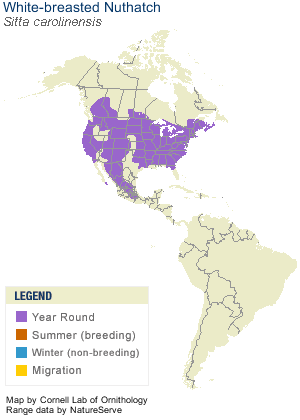
The White-breasted Nuthatch (Sitta carolinensis) is the largest of the four North American nuthatch species. Their habitat is deciduous and mixed deciduous-coniferous forests and treed residential areas (that's me, waving hands).
Pete Dunne describes this bird as "a chunky, neckless, child's fist-sized wind-up toy of a bird...."
Nuthatches get their common name from their habit of jamming large seeds and nuts into tree bark, then whacking them with their sharp bill to
“hatch” out the seed from the inside.
White-breasted Nuthatches store food in cache sites with each storage place containing only one type of food.
Nuthatches do not use their tails for stability as do woodpeckers and Brown Creepers. Instead, one foot is used to brace the bird against the tree, the other foot holds onto the bark.
Range Map & Info source:
Birds of Canada
All About Birds
Pete Dunne's Essential Field Guide Companion
I suppose it is warm somewhere today - it isn't here. I'm not leaving for my winter vacation for another six weeks and I'm tired of looking out the window and seeing white (as in snow).
What better time to sort through the files of downloaded photos from the past year? Let's see what happened on June 26th. Ah, yes, I went for a drive around my area.
One of the very frequent trains on the Canadian Pacific Soo Line; this one coming up from the US, looks like a shipment of new cars and trucks. One of my favourite birding locations is just to the left - Roche Percee Park.
It is always a good day when I find a Cattle Egret (Bubulcus ibis) gracefully moving through the shallows of a prairie slough.
 Looks like a big storm brewing 'over East'.
 Ah, the memories of a warmer time.
Happy New Year, Everyone! And, what better way to start a year than a post about my favourite little birds - Black-capped Chickadees (Poecile atricapillus)
Who hasn't held out a handful of sunflower seeds, hoping a friendly, curious little chickadee will momentarily perch on a finger while taking a seed? Or, smiled on hearing the familiar chickadee-dee? (I suppose the non-nature lover types haven't, but those people aren't likely to be here reading anyway).
As familiar one is with this perky little bird, All About Birds has some Cool Facts, you might not know.
- The Black-Capped Chickadee hides seeds and other food items to eat
later. Each item is placed in a different spot and the chickadee can
remember thousands of hiding places.
- Every autumn Black-capped
Chickadees allow brain neurons containing old information to die,
replacing them with new neurons so they can adapt to changes in their
social flocks and environment even with their tiny brains.
(It is quite probable that I, too, have allowed my brain neurons to die en masse, yet don't seem to have replaced them. I do not recall much of anything useful anymore and don't adapt as easily to change as I used to. I certainly wouldn't remember where I stashed any great number seeds. Oh, to be a 'tiny-brained' chickadee!).
- Chickadee
calls are complex and language-like, communicating information on
identity and recognition of other flocks as well as predator alarms and
contact calls. The more dee notes in a chickadee-dee-dee call, the higher the threat level.
- Winter
flocks with chickadees serving as the nucleus contain mated chickadee
pairs and non-breeders, but generally not the offspring of the adult
pairs within that flock. Other species that associate with chickadee
flocks include nuthatches, woodpeckers, kinglets, creepers, warblers and
vireos. (No warblers or vireos in winter here in the Canadian prairies - not for long, anyway.)
- Even when temperatures are far below zero (F),
chickadees virtually always sleep in their own individual cavities. In
rotten wood, they can excavate nesting and roosting holes entirely on
their own.
- Most birds that associate with chickadee flocks respond
to chickadee alarm calls, even when their own species doesn’t have a
similar alarm call.
Pete Dunne's Essential Field Guide Companion is just about my favourite birding book and constant reference tome. BUT, I must take issue with Mr. Dunne in regard to his comments about Black-capped Chickadees. He describes them as: portly and robust. All right, that's fair enough. However, when comparing them with the Carolina Chickadee he says:
"Black-capped is a larger, more contrasting, more disheveled-looking chickadee than Carolina"
and
"Black-capped looks like a scruffy ruffian of a chickadee; Carolina looks like a nice, well-groomed, well-bred chickadee"
Oh, puh-leese. Those Southern Belle Chicks wouldn't last a minute Up Here.
Pfffttttt!
Information sources:
All About Birds
Pete Dunne's Essential Field Guide Companion
I have had two Northern Flickers (Colaptes auratus) coming to my feeders today. One is a Red-shafted female, which is unusual for my area as I live in the eastern prairies. The other flicker is this one.
This is a hybrid or intergrade male, with the grey-crowned head and facial colouring of a Yellow-shafted, but with the red moustache of a Red-shafted (black in a Yellow-shafted)
There's a hint of the Yellow-shafted's red crescent at the nape
 And, for the heck of it....flicker tongue!
I heard this fella singing/calling from a neighbour's tree when I went outdoors earlier to fill feeders. Very shortly, the Red-shafted female joined him.
Another Christmas has wrapped up. I've been on and off with the enthusiasm this holiday season. The weather makes such a difference to me - and it has been too very cold for nearly all of December.
BUT, yesterday we had a break. It was -4C. It was even sunny! I went off on my now-traditional drive around the countryside, looking for birds and generally enjoying whatever I find.
Some scenes captured along the way:
Many Canada Geese in residence at Boundary Dam. Half of the reservoir is ice-free all winter. This is at a warm water bay. (The reservoir is used as cooling water for the electricity-generating turbines at the power plant)
There isn't a great lot of snow around, compared to places north of here. Fingers crossed it stays like this.
My favourite little farm with the beautiful Percheron horses. Had only a minute or so to snap a quick photo as the farm dog, a large golden lab, was racing my way to check out why a vehicle was stopped at his farm. Generally, I try not to stop near farm building as it really is a bit disconcerting for the people living there. I just had to get a shot of this colourful scene, though.
A Snowy Owl (Bubo scandiacus), one of four seen during the drive. There is a Snowy Owl irruption down into the Eastern US this year. We always have a few of these wonderful birds visiting during the winters. Fuzzy photo - he was quite a distance away, but I had to try for a shot.
I hope everyone had a pleasant Christmas.
Today I went out driving around part of my usual winter birding route. Nothing, Nothing, Nothing. I don't blame the birds for not being here this year. We had a disgusting deep cold spell - as has most of North America - since early December. There just aren't many birds of any kind.
There was, however, this quite magnificent male Ring-necked Pheasant (Phasianus colchicus)
in a Sea buck-thorn shrub (well, I think it is Sea buck-thorn). I had exactly enough time to stop my vehicle, grab my camera, turn it on, back the vehicle up and snap a single photo before Mr. Handsome flew off.
If this is, in fact, a Sea Buck-thorn (Hippophae rhamnoides L.), its berries are very high in protein, vitamins
C and E, and organic acids.