Wednesday, February 8, 2012

Another Brilliant Prairie Sunrise

For just a few minutes on Monday morning, the south-eastern sky looked like this.

Sunday, February 5, 2012

Freezing Foggy Morning

A freezing fog moved into my region sometime Friday night.  The air temperature hovered around -3C.  At 9:00 a.m., yesterday (Saturday) I started a drive around my usual birding route. 

The sun looked like this


And the countryside was coated in magical frost.


Frosty mornings are very quiet.


I saw no birds at all until this flock of 15-20 Common Redpolls flew from one frosted tree into some also-frosted low shrubs


This scraggly weed never looked so pretty as it did yesterday.


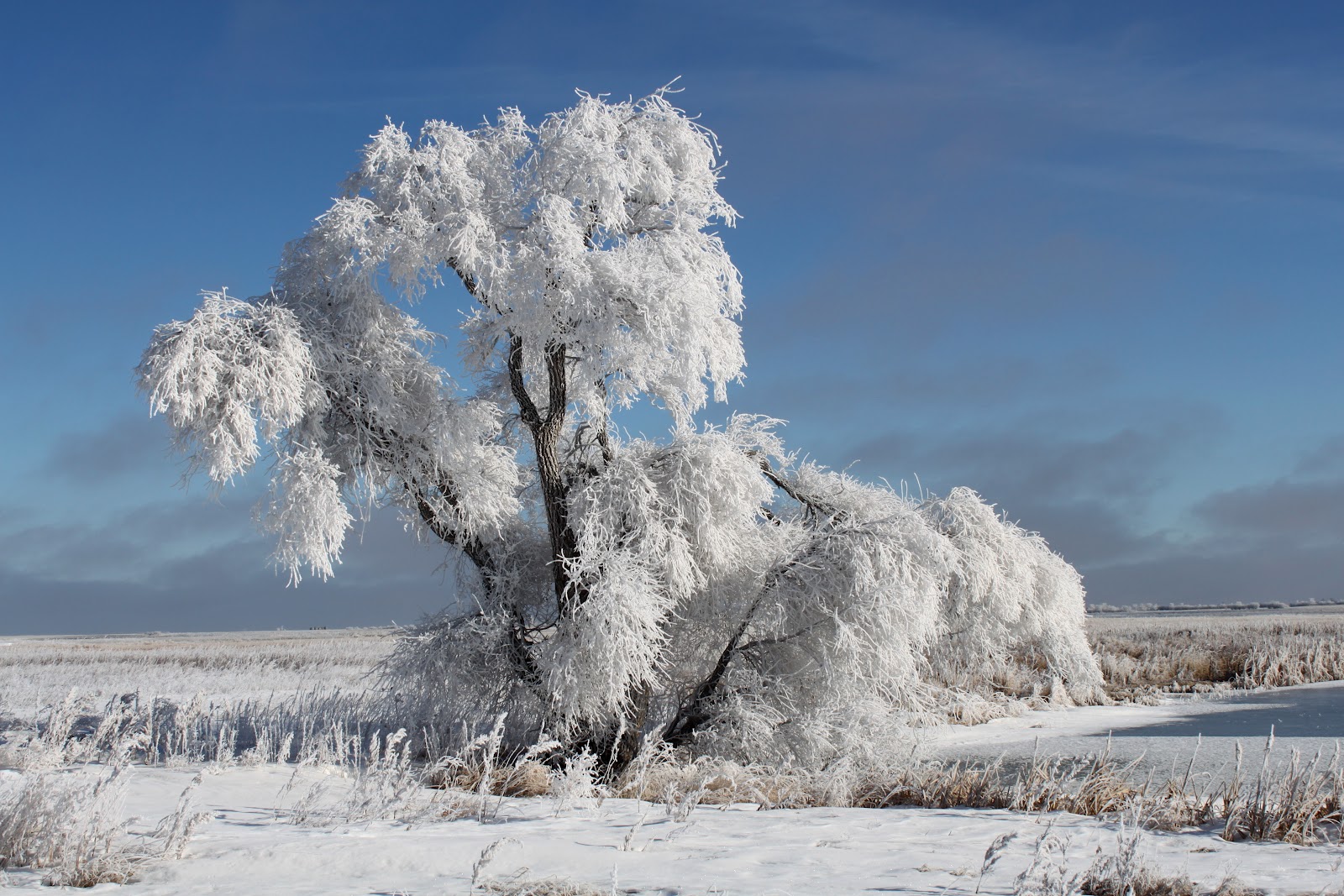
Then the fog burned away, moved off to deposit icy crystals somewhere else.  This lone tree beside a pond is stunning against the bright blue sky.


And, finally, the white (leucistic) finch showed up at the feeders late yesterday afternoon. 


Beautiful day.

Thursday, February 2, 2012

Leucistic House Finch

House Finches are quite variable in the amount of streaking, the extent of red areas and in the shades of red.  I currently have several bright red males, at least one orange and a couple weeks ago...a partially white bird.


Abnormal pigmentation is usually means there's been a glitch in the bird's genetic processes involved with deposition of pigments when the feathers are being formed but sometimes disease and diet can be factors that interrupt the pigment placement.


According to Cornell Lab of Ornithology's Handbook of Bird Biology, pages 3-50 to 3-52, there are three main types of pigments found in birds: melanins, carotenoids and prophyrins.   Since porphyrins probably aren't involved, I'm going to leave them out of this little discussion. 

Melanins are deposited on skin and feathers as tiny granules.  They are the most common pigment, producing shades from blacks to browns, red-browns, yellows and pale yellows (eg. the yellowish down of young chickens).  Birds synthesize melanins from amino acids acquired through their diet.

Carotenoids produce reds, oranges and many yellows.  They are synthesized only by plants, therefore, birds must acquire them through their diets - either by 'eating the plant substances or eating something that has eaten the plants'


In an article titled Bird Leucism at About.com, Melissa Mayntz says:
The degree of leucism, including the brightness of the white and the extent of pigment loss, will vary depending on the bird’s genetic makeup. Birds that show only white patches or sections of leucistic feathers – often in symmetrical patterns – are often called pied or piebald birds, while birds with fully white plumage are referred to as leucistic bird.
 And
Leucism, or leukism, is an abnormal plumage condition caused by a genetic mutation that prevents pigment, particularly melanin, from being properly deposited on a bird’s feathers. 


Shortly after these photos were taken, my area was hit with a sudden and extreme drop in temperatures.  It was -30 pretty well steady for 3-4 days, with a brisk wind creating a windchill factor of -41C. 

Mayntz again:

While leucism can be unusual and exciting for a birder to see, birds with the condition face special challenges in the wild. Lighter plumage may rob the birds of protective camouflage and make them more vulnerable to predators such as hawks and feral cats. Because plumage colors play an important role in courtship rituals, birds with leucism may be unable to find strong, healthy mates. Melanin is also an important structural component of feathers, and birds with extensive leucism have weaker feathers that will wear out more swiftly, making flight more difficult and eliminating some of the bird’s insulation against harsh weather. White feathers also reflect heat more efficiently, which can be fatal for birds that rely on sunbathing and solar radiation for heat in northern climates.

The warmer weather has now returned, but I haven't seen the white finch at the feeders.  


Reference articles and general reading on Leucism/leucistic birds:

Bird Leucism
http://birding.about.com/od/identifyingbirds/a/leucism.htm

Sibley's   Abnormal coloration in birds: Melanin reduction

http://www.sibleyguides.com/2011/08/abnormal-coloration-in-birds-melanin-reduction/

Carotenoid Pigments in male house finch plumage in relation to age, subspecies and ornatmental colorations


Wednesday, January 25, 2012

Coots & Ice

I went around my 'usual' birding route yesterday.  As always, there are thousands of geese at Boundary dam reservoir; most are Canadas but a small portion are Cackling.  I saw a few feeding flocks that had a few of these small Canada Goose look-alikes.  (No photos to show today).

A young Golden Eagle (Aquila chrysaetos) was patrolling the water and circled around to check out the dirty white vehicle arriving in its territory.  I had time for a quick snap through the windshield. 


This is part of the reservoir.


At the boat launch, wave action and steam rising during the deep freeze last week coated the floating wharf with an attractive layer of ice.  One of the seven or so resident American Coots (Fulica americana) was over having a snoop around.  Usually the coots stay on the opposite side, close to the hot water outflow. But, it was a lovely, +1C day yesterday.


During last week's dive in temperature (-30C) with -41C wind chills for several days, I worried about the Snowy Owls (and everything else having to survive outside).  I drove around a bit on Saturday but didn't see any owls.  Yesterday, however, one of the juvenile Snowy Owls  (Bubo scandiacus) was back on its favourite pole.  Too far away to show clearly, but there is some blood on the bird's right leg...it might be holding down a freshly caught, very unfortunate, rodent of some sort.


Thursday, January 19, 2012

A Strange Looking Grackle

This Common Grackle (Quiscalus quiscula) has been around my neighbourhood on and off for the past month.  It first flew into my yard and feeders after an icy rain.  I thought it had bits of ice clinging to its feathers and probably wouldn't survive for long.  Turns out, it is just a teensy bit leucistic.


Leucism is a genetic abnormality wherein pigment, particularly melanin, is not properly deposited on the feathers resulting in white patches or diluted colour or in extreme cases, no colour at all.

I think 'piebald' seems appropriate.


Better yet, polka dot.


And another example of my stellar photography!


Up-Date:  I guess I don't look up Common Grackles in my many field guides very often.  I was looking at this last photo this morning and realized how bronze this bird is.  There are two subspecies of Common Grackles:  'Bronzed Grackle' Q. q.versicolor and 'Purple Grackle' Q.q. quiscula

The bronzed type is the one most frequently found throughout the grackle range in North America.

The purple subspecies is found in the SE states.

More leucistic birds to come! 

Reference:

Never Doubt.....

Back shortly with a couple new bird posts....but in the meantime, let's revisit my favourite quote by Margaret Mead:

Friday, January 13, 2012

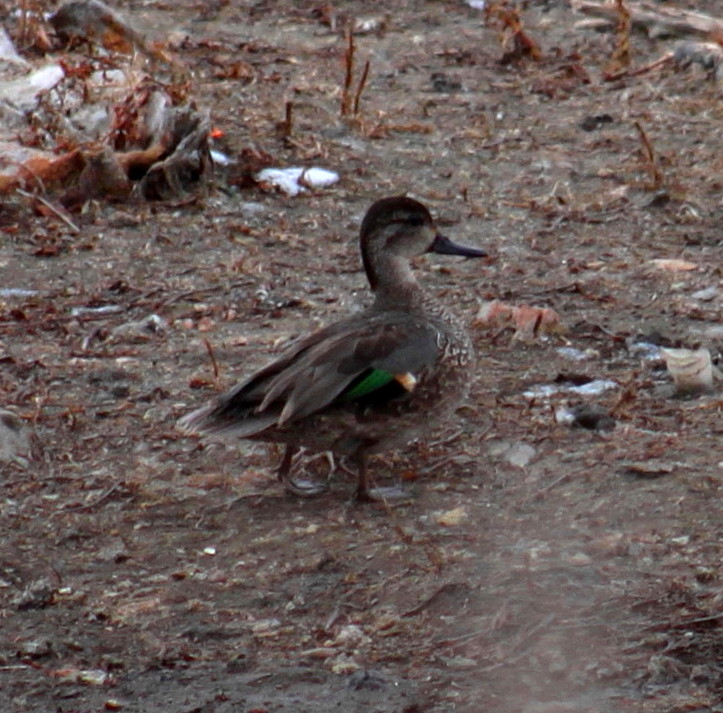
This Female Green-winged Teal

shouldn't be here - at least, not in the Winter.  She should be down in the southern states. 


At first I thought she was wounded as she would just hop out of the water (at the sewer lagoons*) when I drove by.  However, one day she rose up with the Mallards.   Who knows why a few birds miss the last migration bus leaving late Fall, but there are always a few, especially around areas which have year-round open water (such as here).

This little duck - and Green-winged Teals (Anas crecca) are tiny at 14" in length, wing-span 23" - was easily spotted among the mammoth Mallards (length 23", wing-span 35").

Of course, the bright green wing patch (speculum) made for a quick identification.


Green-winged Teals prefer shallow ponds and mudflats so it isn't surprising this one would be at the lagoons.

* Sewer lagoons are great places to look for birds, especially shorebirds during migrations.  No, not the nicest smelling places at times, but hey, it is our own waste by-products, after all.

More info on Green-winged Teals at
http://www.allaboutbirds.org/guide/green-winged_teal/id/ac

Thursday, January 5, 2012

Gyrfalcon!

Well, this was a nice start to the 2012 Bird List!  A white Gyrfalcon (Falco rusticolus) on top of some old strip-mining overburden piles (in a way, I hope these piles aren't reclaimed and levelled off into rolling hills - this will be the only time anyone ever hears me say such a thing.)

See it, way up there?


Warning:  fuzz-zee photo.  I did not have a tripod but I also wouldn't have had time to set-up.  We didn't know how long this bird would perch.  I think this is a juvenile white-morph, but the vote is still a little bit out among my fellow birder Guy Wapple (and fellow-sighter of this bird) and some of his pals. 

The Gyr is the largest falcon; a stocky bird, about 22 inches in length, with a wing-span of 47".  It is a very strong, swift flier, with slow wing-beats.  

Falcons use their large powerful feet to knock prey out of the air and/or otherwise disable.  Falcons have notched beaks (you can sort of see that in this pic) which enables them to sever or crush the neck vertebrae of their prey. 


Gyrs are Arctic breeders, nesting on scrapes on the ground.  Some come south in winter, as you can see.  In summer, they feed mostly on ptarmigans.  Down here, this one will be looking for Sharp-tailed Grouse, Ring-necked Pheasants, and ducks.  We have many, many ducks on the open water at Boundary.  It won't go hungry.

This is only my third Gyrfalcon (pronounced GER-falcon)  I posted about a juvy grey-morph here http://stilllifewithbirder.blogspot.com/2010/10/gyrfalcon-kind-of-day.html

Info on Gyrfalcons:
http://www.allaboutbirds.org/guide/Gyrfalcon/id/ac
http://en.wikipedia.org/wiki/Gyrfalcon