Wednesday, June 12, 2013

Wrangling The Wood-Pewee


A little flycatcher has been visiting my back yard recently, perching on the utility wires, alertly snapping up hapless insects flying by.  

It certainly was a Wood-Pewee, but which one? They are virtually identical; well at least they are to me.


One morning, the bird was back out fly-catching from a favoured spot on a utility wire to my house.  I watched, and then heard a clear, sweet peee'yer.   Exactly the same sound as the first part of the usual two-part Eastern's song.  

And to be 'sure', I listened to several versions of the Western's song on various bird sound CDs and on-line sources.  Very different sounds, quite burry and more robust.

All right!  My bird is an Eastern!


Ah, but then I started to have my doubts shortly after posting my 'positive idenitifcation' on Facebook.   (Isn't that annoying!)


The bird continued to fly-catch around my yard, but less frequently and I began to hear a distinctly burry "whjeeeer" in the distance of a neighbour's yard when the bird wasn't present in mine.  Okay, that is a Western Wood-Pewee singing.

Hmmmmmm.......


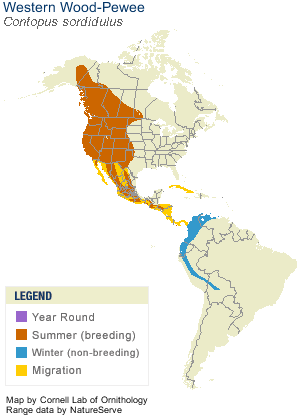
Could both species be here?  Yes,  I live in the over-lap part of their ranges,  in the SE corner of Saskatchewan.  I often see and hear the Eastern bird down along the river.  The Westerns....not often right in this area.

See range maps below.


This morning, thinking I should really do something or other with  this blog post (I had loaded the photos last week), I pulled out one of my many field guides just to have another consideration of my little mystery bird.  And there, at the bottom of the description of the Western Wood-Pewee, Ted Floyd has remarked in the Smithsonian Field Guide to the Birds of North America:
Song generally distinct from Eastern; a down-slurred jeeer, much harsher than Eastern.  At any time of year, can give sweet peeya notes, recalling Eastern  (my underscore emphasis).
So, I think my little bird above is a Western Wood-Pewee....or not.....could be two different birds, but I don't think so.  Frankly, I don't recall having either one as yard birds before.

All the fly-catchers give me a headache!


Range Maps (courtesy of All About Birds)
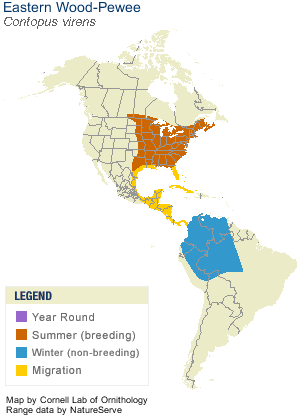
Eastern Wood-Pewee Range Map 
----------------------------------
Western Wood-Pewee Range Map


Information sources:

All About Birds 
Smithsonian Field Guide to the Birds of North America

Friday, June 7, 2013

Sights From Yesterday's Drive

Yesterday morning I tossed all plans of a garden-work day aside...the weeds will wait.  A mostly warm and sunny day, after several days of rain, was beckoning me out onto the roads.  I travelled around part of my extended birding route, checking out points to the north and west of me. 


Cattle Egrets (Bubulcus ibis)  There were 3 at the Midale/Macoun Marsh.  One bird was in high breeding plumage, with a very bright red bill (and legs, which aren't seen in this photo)


 The other two were of this plumage, legs to match the bill. 


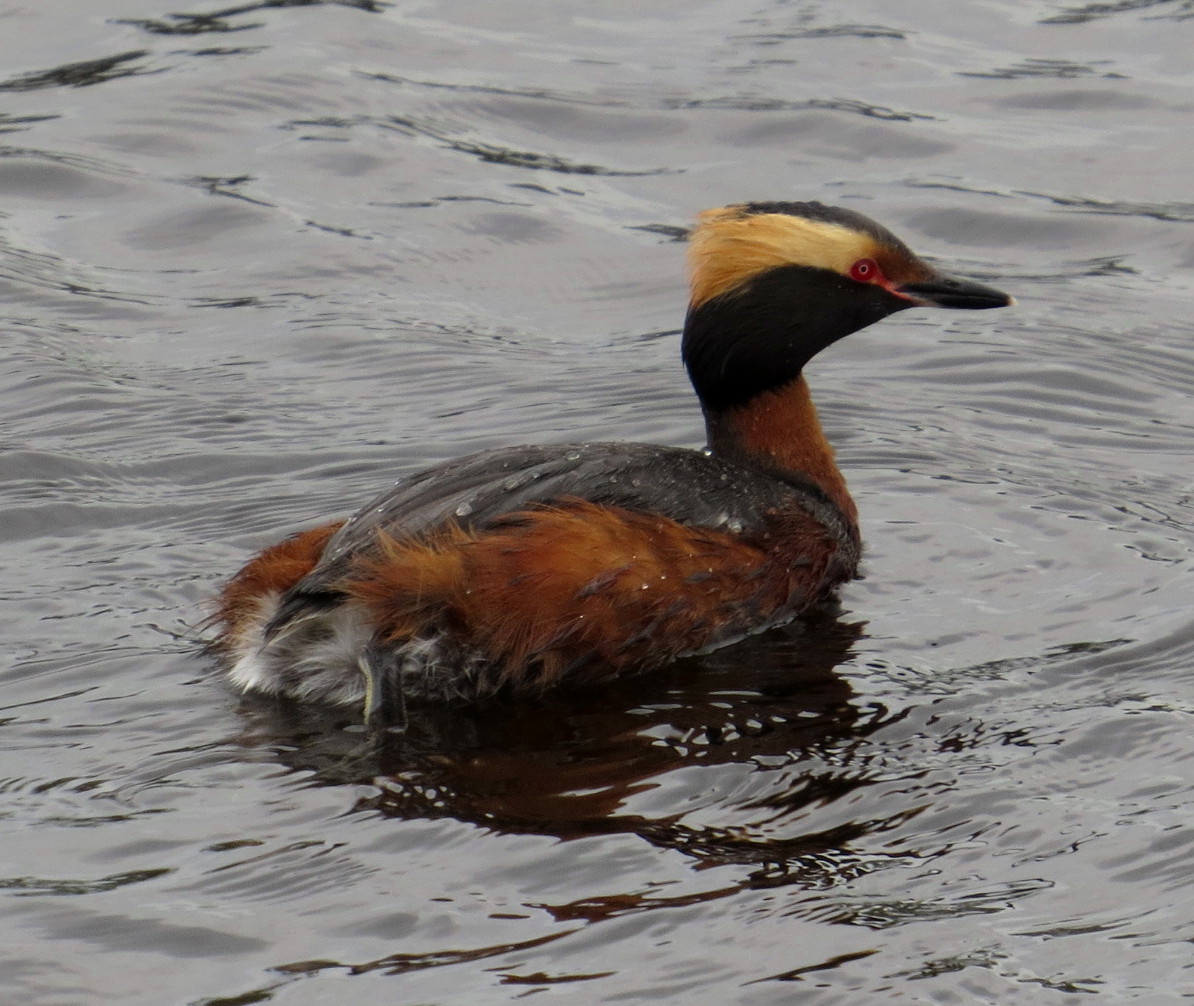
Horned Grebes (Podiceps auritus) are common here, but seldom as co-operative for an impromptu photo-shoot as this one was.


A Red-necked Grebe (Podiceps grisegena) puffed out its topknot but kept its distance.


And, the beautiful little Eared Grebe (Podiceps nigricollis)


Spring seeding is still in progress around here, in between massive rainfalls.  I pulled off the road to let this monster sprayer zoom by.  (No comment!)


Back to the soothing pasture land, which our Fed & Provincial gov'ts are trying to sell-off.....

The  Common NIghthawks (Chordeiles minor) returned this past week.  Wonderful birds, nighthawks.


Road bans are on, plus we had a few inches of rain lately.  This rig was hauled in early and is waiting for things to dry up.  Too bad it is just a short distance away from a former Burrowing Owl pasture (last year, the owners of this tiny bit of native prairie plowed up 75% of it and planted corn.  If the owls returned, they didn't stay long enough to breed.  Yesterday there weren't any owls around....so thanks a lot, Mr. Farmer).


It is hard to see an Upland Sandpipier (Bartramia longicauda) when it has landed in a stubble or lightly-worked field. 


Last but definitely not least, a very bubbly Bobolink male, doing his very handsome best to attract a lady BOBO. 

 
It was a very lovely and relaxing day.  As I said, the road bans are still on, so the back roads were fairly quiet.

Tuesday, May 28, 2013

Tail End

Looks like some new Cooper's Hawks  (Accipiter cooperii)  will be appearing in the not-too-distant future.


This is likely a female COHA Jared Clarke and Kristin Marten banded a few years ago (with Larry Preddy & I helping a teensy bit).  A pair returns to this particular nest every couple of years.  

Here is a photo of a different COHA after banding.


Beautiful birds.


Wednesday, May 22, 2013

Red Sprite Lightning

I haven't posted an Astronomy Photo of the Day (APOD) for a long time.  

There are two sky phenomena that intrigue me greatly:  the auroras and lightning.  

Today's APOD shows a very uncommon set of events...Northern Lights as far south as South Dakota, a clash of storm systems, and the creation of a Red Sprite...caught on camera.


APOD Explanation: What's that in the sky? It is a rarely seen form of lightning confirmed only about 25 years ago: a red sprite. Recent research has shown that following a powerful positive cloud-to-ground lightning strike, red sprites may start as 100-meter balls of ionized air that shoot down from about 80-km high at 10 percent the speed of light and are quickly followed by a group of upward streaking ionized balls. The above image, taken a few days ago above central South Dakota, USA, captured a bright red sprite, and is a candidate for the first color image ever recorded of a sprite and aurora together. Distant storm clouds cross the bottom of the image, while streaks of colorful aurora are visible in the background. Red sprites take only a fraction of a second to occur and are best seen when powerful thunderstorms are visible from the side.  

http://apod.nasa.gov/apod/

Tuesday, May 21, 2013

First-of-Year Hummer

I've had my hummingbird feeders up for about a week in anticipation of a cold, tired, hungry little bird-soul showing up.

And one did this morning.  My first-of-year Ruby-throated Hummingbird (Archilochus colubris)


He had his feathers all puffed up.  It is a chilly +8C/~47F


 I hope this is the first of many.  I don't get a lot of hummers, but usually have at least one nesting somewhere in the neighbourhood trees.

Sunday, May 19, 2013

A Few Yard Birds

Gardening, bird-watching and a bit of photography.....that's about all I'm doing these lovely Spring days.

As of Thursday, my yard was busy with birds:  Rose-breasted Grosbeaks, American Goldfinches, House Finches, Pine Siskins, Harris's Sparrows, Red-winged Blackbirds and Baltimore Orioles, to list a few.

A male Red-winged Blackbird (Agelaius phoeniceus) doing a display of dominance or territory or something - I love watching blackbirds, by the way.


And their Icterid cousins, the beautiful Baltimore Orioles (Icterus galbula) 


A female oriole


Another handsome male.


A female Tennessee Warbler (Vermivora peregrina) sipping on the flowering plum.  I'm glad she likes them; the plum flowers have a beautiful scent.


A wonderful male Rose-breasted Grosbeak (Pheucticus ludovicianus).  There is something very calming about Rose-breasted Grosbeaks.  This fellow pretty much sat in the same tree all one day.  The next day, several more males and a few females arrived and things did get a little more active.  However, they don't bicker and squabble like the blackbirds and orioles.  Each movement is very studied and slow.


An American Goldfinch (Carduelis tristis) taking a little exception to the arrival of a House Finch (Carpodacus mexicanus).  Peace prevailed, with each moving a trifle farther apart.

 
Can't wait to see what will be around tomorrow! 

Sunday, May 12, 2013

Struttin' Tom, Terrific

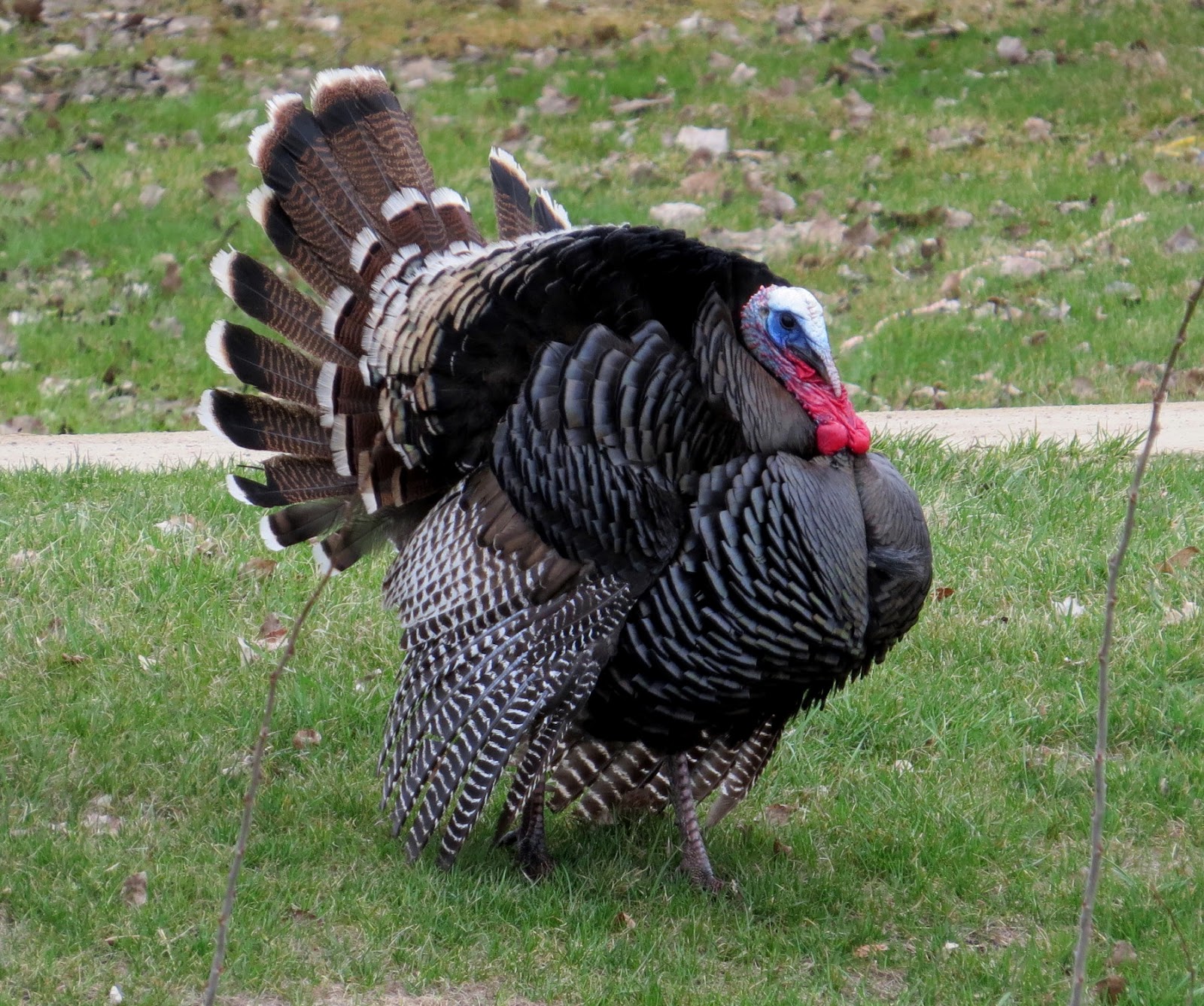
Early this past Friday morning, on a quiet road in SW Manitoba, I watched this spectacular Wild Turkey (Meleagris gallopavo) tom strut his stuff for a couple of his lady friends.  

Although a native species to Mexico, which is part of North America as far as geography goes, to the birding community this is an introduced/reintroduced species (as is the Gray Partridge, Chukar and Ring-necked Pheasant).  Depending on the given birder, the Wild Turkey may or may not be deemed worthy of a check-list tick.  I'm not a stickler.  My list criteria is that the birds are now a living and breeding population in the wild. 


We have a few Wild Turkeys in my area, usually along the Souris River valley.  The floods of 2011 took quite a toll on those small populations, so I don't see them often at all.  

And if I do find a male displaying in the Spring, the camera comes out


Pete Dunne calls it The Great American Forest Fowl.  It is true, they forage on the forest floor, raking through the leaf litter looking for nuts, fruits, berries, seeds, tubers...depending on the season and what's around. 

Cool Facts from All About Birds:
  • The Wild Turkey and the Muscovy Duck are the only two domesticated birds native to the New World.
  • In the early 1500s, European explorers brought home and domesticated Wild Turkeys from Mexico. They quickly became popular on European menus thanks to their large size and rich taste from their diet of wild nuts. Later, when English colonists settled on the Atlantic Coast, they brought domesticated turkeys with them.
  • The English name of the bird may be a holdover from early shipping routes that passed through the country of Turkey on their way to delivering the birds to European markets.
  • When they need to, Turkeys can swim by tucking their wings in close, spreading their tails, and kicking.
  • As Wild Turkey numbers dwindled through the early twentieth century, people began to look for ways to reintroduce this valuable game bird. Initially they tried releasing farm turkeys into the wild but those birds didn’t survive. In the 1940s, people began catching wild birds and transporting them to other areas. Such transplantations allowed Wild Turkeys to spread to all of the lower 48 states (plus Hawaii) and parts of southern Canada.  (Note:  the subspecies found out here in the West has white tips to the tail and back feathers, like the original Mexican subspecies, while the eastern birds are all dark. )
  • Because of their large size, compact bones, and long-standing popularity as a dinner item, turkeys have a better known fossil record than most other birds. Turkey fossils have been unearthed across the southern United States and Mexico, some of them dating from more than 5 million years ago.

All right, I guess we didn't need to see that!


All About Birds continues:

Wild Turkeys get around mostly by walking, though they can also run and fly—when threatened, females tend to fly while males tend to run.

At sundown turkeys fly into the lower limbs of trees and move upward from limb to limb to a high roost spot. They usually roost in flocks, but sometimes individually. 

Courting males gobble to attract females and warn competing males. They display for females by strutting with their tails fanned, wings lowered, while making nonvocal hums and chump sounds.

Males breed with multiple mates and form all-male flocks outside of the breeding season, leaving the chick-rearing to the females, The chicks travel in a family group with their mother, often combining with other family groups to form large flocks of young turkeys accompanied by two or more adult females. 

Each sex has an independent pecking order, with a stable female hierarchy and a constantly changing male hierarchy. 

Wild Turkeys are hunted by coyotes, bobcats, raccoons, mountain lions, Golden Eagles, Great Horned Owls, and people. Nest predators include raccoons, opossums, striped skunks, gray foxes, woodchucks, rat snakes, bull snakes, birds, and rodents

Information sources:
All About Birds/Wild Turkey

Sunday, April 14, 2013

Ferruginous Hawk

Most birders have a favourite raptor.  Mine is the Ferruginous Hawk (Buteo regalis).
This is a hawk of my beloved wide-open prairies.  Pete Dunne calls it Russet-backed Prairie Eagle.  


The sexes are similar.  This bird is a 'light morph'.  Notice the rusty shoulder patches, white underparts, light coloured head, pale tail.  The gape (or the lips, if you will) is extended and yellow - gives the bird a smiley look.

 
A couple of Cool Facts from All About Birds:

-  Before the elimination of bison in the West, nests of the Ferruginous Hawk were often partially constructed of bison bones and wool


- The Rough-legged Hawk, the Ferruginous Hawk and the Golden Eagle are the only North American hawks to have legs feathered all the way to the toes.

Ferruginous means rusty-coloured.  Note the rusty markings and also long, pointed wings and the white base of the primaries.


Not long ago, Ferruginous Hawks were considered pests by farmers & ranchers (and honestly, what wasn't?).  So, they were shot and poisoned (again, what wasn't, or isn't?).  But, then it was realized that the hawks primarily fed on ground squirrels and pocket gophers which farmers & ranchers find to be even greater pests.  So nowadays, these lovely great hawks are considered 'friendly'.  It might take a little while for the reactive farmers & ranchers to a) stop poisoning the ground squirrels and b) cultivating the ever dwindling open prairie so necessary for my beautiful hawks to survive.  Note:  I grew up on a farm here on the southern Saskatchewan prairie.

This species is considered threatened in Canada.  

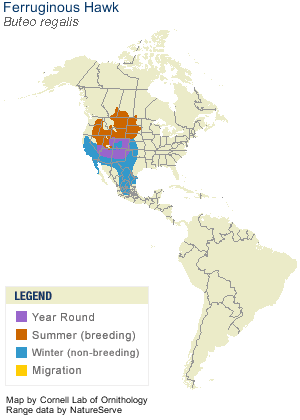
I am lucky to live where there is still a bit of natural prairie left (not much and the community pastures are being sold off, remaining private pastures are being cultivated and seeded to grazing hay). Several pairs of FEHAs return to this area yearly, reusing their nests.

Range Map below.

Ferruginous Hawk Range Map

All About Birds
Pete Dunne's Essential Field Guide Companion
Birds of Canada

Wednesday, April 10, 2013

Common Redpolls - Smart Birds

I have a lack of redpolls!  The past couple of days, the 100+ Common Redpolls (Carduelis flammea) that wintered in my neighbourhood have gone. There are only 2-3 around my yard now.

Actually with this never-ending Winter of 2013, they have lingered here longer than usual, giving us nice looks at the very bright rosy-red breeding plumage.

 
Pete Dunne calls them the Catkin Finch and says this northern finch loves birch catkins - simply loves themI don't have birch.  I toss out seeds in the winter.  That works, too.


Quoting P. Dunne once again, he describes the CORE as a "streaky, stubby, effervescent pip-squeak of a finch with a small red beret and a black goatee."

These birds are smaller than House Finches.  They are a little bigger than a Pine Siskin, with which the less showy female redpoll can be confused (until one sees the jaunty red cap).
 
 
These personable little birds are arctic and subarctic breeders.  All About Birds provides us with this little cool fact:
Common Redpolls can survive temperatures of –65 degrees Fahrenheit. A study in Alaska found redpolls put on about 31% more plumage by weight in November than they did in July.   During winter, some Common Redpolls tunnel into the snow to stay warm during the night. Tunnels may be more than a foot long and 4 inches under the insulating snow.
I’ve never seen evidence of this, but then we don’t get quite as cold as –65F....close but not quite....at that temp, I’d probably be a little busy tunnelling into the snow myself to notice what birds are digging along side of me. 


Another fun fact:   Animals behaviourists commonly test an animal’s intelligence by seeing if it can pull in a string to get at a hanging piece of food. (I’m not making this up). Common Redpolls pass this test with no trouble. They’ve also been seen shaking the seeds out of birch catkins, then dropping to the ground to pick them up from the snow surface.

And: Redpolls have throat pouches for temporarily storing seeds. They may fill their pouches with seeds quickly then fly away to swallow the seeds in a more protected, warmer spot.

 
The fun facts with these birds never end.....here's yet another one:
Redpolls breed in all the the lands that ring the Arctic Ocean. A few banding records have shown that some Common Redpolls are incredibly wide ranging. Among them, a bird banded in Michigan was recovered in Siberia; others in Alaska have been recovered in the eastern US, and a redpoll banded in Belgium was found two years later in China.


Info sources:

All About Birds
Pete Dunne's Essential Field Guide Companion 

Sunday, April 7, 2013

American Tree Sparrow

Or, as Pete Dunne calls it, The Winter Chippy.  

The American Tree Sparrow (Spizella arborea) is one of the first sparrows to arrive in my area in the Spring and the last to leave in the Fall.  It winters in southernmost Canada and all over the US.  It breeds in the arctic so doesn't mind a bit of late Spring snow on the trip north.

Three arrived in my back yard this past Monday.  Snow still piled up but a few days of melting have exposed the layers of birdseed I've been tossing around during the past few months of snowdom. 

 
Contrary to the name, this sparrow is found mostly in shrubby areas, weedy fields, edges of marshes, etc.  It nests in stunted willows and spruce in boggy or open areas of the northern tundra.  

This sparrow feeds on the ground in rapid shuffling movements; it will also leap up to grab seeds from tall grasses as well as foraging high in trees, quite liking birch catkins.


The ATSP is a medium-sized, plump sparrow with a small bi-coloured bill - dark upper, yellowish lower - with a richly patterned back and a long tail.
  
It is sometimes confused with Chipping Sparrows as both have rufous crowns and an eye stripe.  However, the ATSP has a rusty brown eye stripe with gray above and belowThe CHSP has a black eye stripe and a white eyebrow.

The Am. Tree Sparrow has a dark breast spot on an unmarked chest.

Information sources:
Pete Dunne's Essential Field Guide Companion

All About Birds