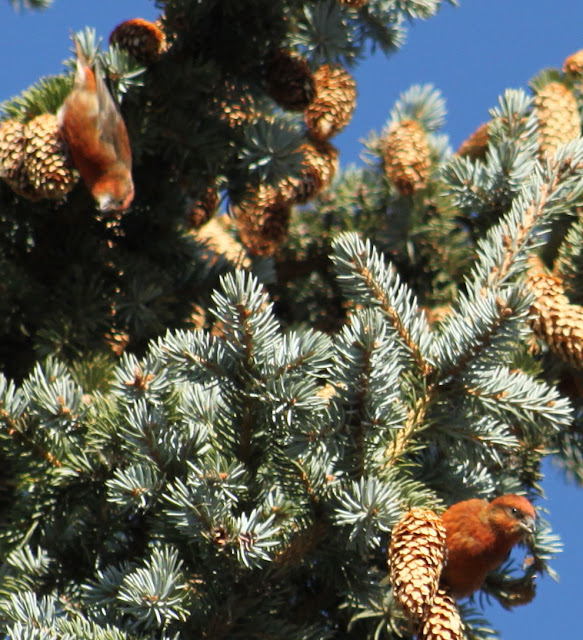
I have never seen Red Crossbills (Loxia curvirostra) here, in Estevan SK, before. Okay, I haven't lived in this house, or even this area all my life, but still....
There they were, way in the top of the tree
...opening the cones with their weird and efficient bills and gobbling the seeds
No white wing bars, so not the White-winged Crossbills I expected to see - and which are often around here at various times during the winter
Sorry, the photos aren't the clearest. I had just pulled into my driveway from an RV trip to Manitoba; was starting to unload the vehicle when I heard some unfamiliar twittering coming from the top of the spruce. After driving most of the day, I was a little wobbly & shaky aiming almost straight up. No time to set-up my tripod. Maybe they will come back today.
For more info & better photos of Red Crossbills, go here:
http://www.allaboutbirds.org/guide/Red_Crossbill/id
This Bald Eagle (Haliaeetus leucocephalus) was a little east of Beausejour, Manitoba
this morning. It was eating something in the ditch and was a tad ticked when I stopping to gawk. Sorry, Baldie.
But, thanks so much for the chance to see you.
As a cold front moved into the area, some straggly mammatus clouds were forming overhead. A cumulonimbus cloud looms in the background. The day (about a week ago) started out warm; we hadn't had rain in weeks; however, there's a lot of water in ponds and sloughs so the air was more humid than usual .
It all looked rather ominous, but other than the wind picking up and a slight drop in temperature, nothing much happened as this bit of weather moved through.
Wikipedia:
Mammatus are most often associated with the anvil cloud and also severe thunderstorms. They often extend from the base of a cumulonimbus, but may also be found under altocumulus, altostratus, stratocumulus, and cirrus clouds, as well as volcanic ash clouds. In the United States, sky gazers may be most familiar with the very distinct and more common cumulonimbus mammatus. When occurring in cumulonimbus, mammatus are often indicative of a particularly strong storm or maybe even a tornadic storm. Due to the intensely sheared environment in which mammatus form, aviators are strongly cautioned to avoid cumulonimbus with mammatus.
Mammatus may appear as smooth, ragged or lumpy lobes and may be opaque or semitransparent. Because mammatus occur as a grouping of lobes, the way they clump together can vary from an isolated cluster to a field of mamma that spread over hundreds of kilometers to being organized along a line, and may be composed of unequal or similarly-sized lobes. The individual mammatus lobe average diameters of 1–3 km and lengths on average of 0.5 km. A lobe can last an average of 10 minutes, but a whole cluster of mamma can range from 15 minutes to a few hours. They usually are composed of ice, but also can be a mixture of ice and liquid water or be composed of almost entirely liquid water.
http://en.wikipedia.org/wiki/Mammatus_cloud
.....mostly Red-wing Blackbirds. This was a couple weeks ago now, out west, south of Bromhead.
There were many such flocks - most have gone south now.
Happy Thanksgiving!
I'm not talkative this morning, so I'll just post some photos from Sunday. It was such a pretty day.
Mountain Bluebirds frolicking about at an old corral
Aspen
Moose Mountain Creek
Gooseberry Lake
There's a juvenile Black-crowned Night-Heron standing in the water
Here's another one, intently hunting near Moose Mountain Dam
Profile
I went looking for Fall Colour yesterday and found some in the prairie pothole area north of Stoughton (~ 50 kms north of where I live)
This is prime waterfowl breeding region
Lots of small sloughs, ponds, marshes surrounded by grain fields or in some cases, especially in the Ocean Man Reserve, original prairie.
The cattails and reeds grew high this year
An abandoned farm along Moose Mountain Creek.
More photos to come
Thousands upon thousands of Killdeer have converged on this area, forming huge flocks. A small flock of 18 birds landed in this field - some shorebirds that were likely plovers but weren't Killdeer.
The prairie soil around here is Dark Brown Chernozemic without much organic matter. Decades of chemical-based farming has pretty much destroyed the soil and now many of the plowed fields are this clumpy grey. I digress....
These juvenile American Golden-Plovers (Pluvialis dominica) blend right in, don't they?
A slightly better view.
Frankly, these Am. Golden-Plovers look like the juveniles of the Black-belled Plovers, another common migrant - except the BBPLs have black axilliary (armpit) feathers in all plumage phases. This bunch had light coloured axillaries. Ergo, AGPL - the other similar plover species likely to be found here. (Qualifier, the Pacific Golden-Plover juveniles are almost identifical, but hey...)
For more info about American Golden-Plovers, go to All About Birds at
http://www.allaboutbirds.org/guide/American_Golden-Plover/id
We are having a lovely, warm Fall so far. I went out for a drive to see what birds are around. Nothing of note except for increasing numbers of Sandhills Cranes, Canada Geese, a few Greater White-fronted Geese and a flock of 42 Am. Crows.
The Mantei-Ribling Marsh is full of water. I guess it was last year as well. However, in the previous 2-3 years, it was bone dry by Fall. Nice to see the water table high, even if there was flooding. Better than the drought.
The prairies don't enjoy the astounding profusion of Fall colours one sees in other parts of the continent. But, perhaps the odd splashes of colour, such as along rivers and creeks, are even more poignant.
This is Wood-End, the Long Creek end of Boundary Dam reservoir, this morning
I love looking at horses. I swing by this farm any chance I get. There are two of these big Percheron draft horses (the other one was off away from this trio). They go to 'pull' competitions.
Click on pix for larger & clearer, if you want to.
There were two Am. Bitterns (Botaurus lentiginosus) in a small marsh beside a road I travelled this morning....one flew farther into the marsh, the other hid among the cat-tails.
I waited, patiently.....
I had no idea bitterns had such long, deadly-looking talons
Bitterns eat amphibians, crayfish and fish
This one steadily kept on walking; no hunting while I was around.
Click on pix for larger & clearer, if you want to.
Have you ever given any thought to how muskrats (Ondatra zibethicus)
spend the long, frozen Canadian Winters?
Well, I can't say for sure, but I saw this muskrat lodge along the highway near White Bear Lake. Is that a....????
Looks like a satellite dish to me.
The mystery may be solved.