Saturday, June 11, 2011

More Pheasant Photos!

This fine fellow was struttin', crowin' and otherwise trying to impress his lady-pheasant one afternoon last week (in my friends' back yard)

Click on pics for clearer and larger, if you want.


Wednesday, June 1, 2011

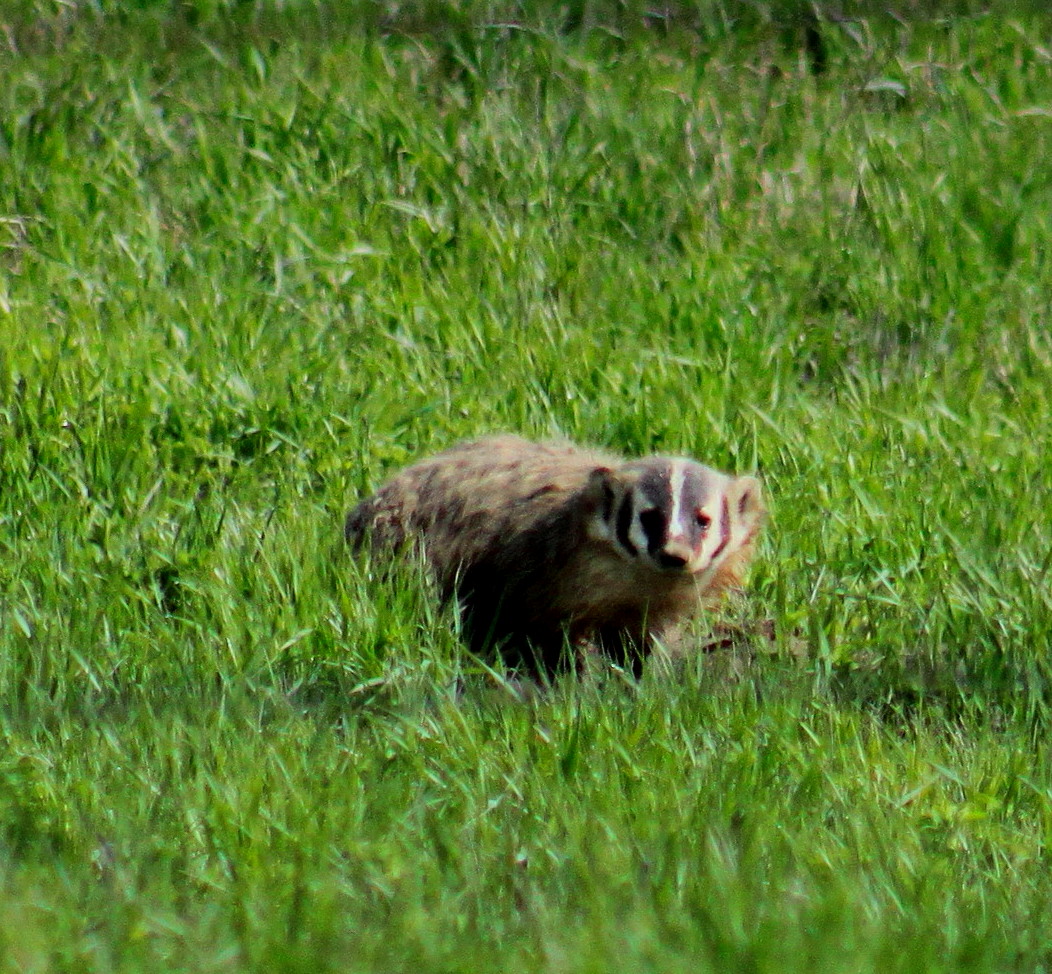
A Huntin' American Badger

I just returned home from the shake-down RV trip of 2011.  Of course the weather didn't co-operate.  It rained - a lot.  Well, it could have been worse, I got snowed on last year's trip....

Anyway, I went to the Cypress Hills and area, which is way over on the west side of the province.  This is possibly my favourite place in Saskatchewan, and maybe pretty well anywhere.  More about this in another post.

I found this beautiful badger hunting ground squirrels early last Sunday morning as I was dawdling along birding the roadside and sloughs.  I was travelling from my overnighting place at Shaunavon*** to Maple Creek where I was meeting my friend Dorothy for lunch.  By the way, this lovely morning was the only sunny one I had during the 3-4 day trip.

My photos aren't as good as they should be considering the animal was reasonably close; however, I was trying not to make any quick movements or sudden noises.  So I was awkwardly draped across the passenger seat, shooting out that window - then my cell phone rang (no one ever calls me; I never have the damn thing on, but I thought maybe Dorothy might need to get hold of me re where to meet, etc.  It was herself on the phone).  Nicely, Badge was intent on grabbing some breakfast, so it didn't run off while I was talking.

American Badger  Taxidea taxus


***Shaunavon is home of Hayley Wickenheiser - best female hockey player in the world - yes, really and the first female to play professional hockey in a position other than as goalie.  I knew that, Wikipedia confirms it. 

Ho-Hum.  I love travelling around my province.  Almost every town of any size has a sign saying home of a hockey player (male or female), a football player, a rodeo cowboy, some other type of athlete or a country singer.  I think it is neat when communities proudly display the achievements of their daughters and sons.

Actually, here's a list of 'Famous People' from Shaunavon, courtesy of Wikipedia
Click on the pix for bigger and clearer, if you want to.  I also did a post in the winter about an American Badger I found alongside a snowy road
http://stilllifewithbirder.blogspot.com/2010/12/american-badger.html

Saturday, May 28, 2011

Orchard Oriole

The Orchard Oriole (Icterus spurius) is the smallest North American member of the Icterids - the Oriole & Blackbird family (Icteridea).  This is an adult male.  The adult female and the juvenile have olive-green on the upper parts and yellowish on the breast and belly. Orchard Orioles are considered to be adults after their second year. One-year-old males are yellow-greenish with a black bib.  (Wikipedia)


Yesterday I thought all the orioles had left.   None visiting the orange/jam feeders.  It was lonely, I tell ya, after some ten days of high oriole activity in the yard and suddenly nothing - not one.  Then, the rain clouds moved in (sigh, we seriously don't need any more rain for a while) and a few Baltimores and two Orchards came into the yard. 


Interesting Facts from WhatBird.com
 - A group of orchard orioles are collectively known as a "harvest" of orioles.
 - It is a late spring migrant, but it heads back southward quickly. Some orioles may return to their wintering grounds as early as mid-July.


The End


Click on pix for larger & clearer, if you want to.

Friday, May 27, 2011

House Wren

I bought this little wren house at the Farmer's Market in Kelowna 5-6 years ago.  I hung it in this particular crabapple tree and not once has a wren considered it habitable.  I mean, really, wrens use almost anything as a nest site.


But...this week, I noticed a wren checking it out.  A while later, it was bringing in little sticks.  How nice. 


All About Birds sums up the House Wren behaviour very well 
Bubbly and energetic, just like their songs. Look for House Wrens hopping quickly through tangles and low branches and, in spring and summer, frequently pausing to deliver cheerful trilling songs.

Tuesday, May 24, 2011

Souris River Yesterday

We got more rain over the weekend.  Yesterday I went out to check the river levels.

At the bridge on #47 south of Estevan


South from the lookout/parking lot above the greenhouses at Shand Power Plant


At the bridge on #39 east of Roche Percee


At Taylorton Bridge


Sunday, May 22, 2011

Eared Grebes

Podiceps nigricollis californicus, or Eared Grebe, is one of my favourite diving birds.  This Spring, we have a lot of them.    According to All About Birds: 
The most abundant grebe in the world, the Eared Grebe breeds in shallow wetlands in western North America. It occurs in greatest numbers on Mono Lake and the Great Salt Lake in fall, where it doubles its weight in preparation for a nonstop flight to its wintering grounds in the southwestern United States and Mexico. 

This is what they look like in their Adult Summer (breeding) plumage.   The juveniles and adults in their wintering grounds don't look quite this spiffy - generally varying shades of dark grey.


Podiceps nigricollis is found on every continent except Austratlia and Antarctica.  In all those other, non-North American places, it is known as Black-necked Grebe.  From Wikipedia

The latter (name) was first used in 1912,  Ernst Hartert, in an effort to bring the common name of the species in line with its scientific name. The genus name of this species—Podiceps—comes from two Latin words: podicis, meaning "vent" or "anus" and pes meaning "foot". This is a reference to the attachment point of the bird's legs—at the extreme back end of its body. The specific epithet nigricollis is Latin for "black-necked": niger means "black" and collis means "neck". 


I also found this little tidbit in Wikipedia
 
Interestingly, the eared grebe is essentially flightless for most of the year (9 to 10 months), and serves as an example of one of the most inefficient flier among avifauna. Generally, this bird avoids flying at all costs and reserves long distance flight exclusively for migration. However, when migrating, it will travel as much as 6000 km to reach prosperous areas which are exploited by few other species. (Jehl Jr. et al., 2003)


[This grebe is] an excellent swimmer and diver, and pursues its prey underwater, eating mostly fish as well as small crustaceans, aquatic insects and larvae. It prefers to escape danger by diving rather than flying, although it can easily rise from the water. 

Follow the links for more info at All About Birds and Wikipedia.
Click on the pix for larger and clearer, if you want to.


Tuesday, May 17, 2011

Yard Birds

This gloomy, cloudy, very windy Tuesday has been considerably brightened-up by the arrival of two male Baltimore Orioles (Icterus galbula).


I've had the oranges out for a few days awaiting their arrival.  It's too bad I didn't get my act together about washing windows - these photos were taken from inside my house through those same dirty windows.  Tsk.

 
As we speak, one is sitting near an orange and issuing a loud single note call while looking around to see if anyone is paying him attention.


The House Finches  (Carpodacus mexicanus) like oranges too.


There's about 20 American Goldfinches (Carduelis tristis)  feeding at the niger sock and sunflower feeders - always a delight.


And the female Purple Finch returned for some seed as well.  I haven't seen her male counterpart.


Several Harris's Sparrows (Zonotrichia querula) are continuing their stay.  They are definitely my favourite sparrow species.


Click on pix for larger and clearer, if you want to.

Monday, May 16, 2011

White-tailed Jackrabbit

Lepus townsendii, just recently changed from the all-white winter coat to the fashionably neutral sandstone brown summer wear.


Leave me alone, please just leave me alone.


All right, I shall share bit of info if you promise to go away:  My ears are rather huge.  It's hot around here in the summer.  The large ears help to dissipate heat.  They also help me to hear very well.  Good thing, too, as pretty well everything wants to make a meal of me: coyotes, fox, cougars, bobcats, eagles, owls, hawks, you name it.  (Hey Mr/Mrs Jackrabbit - stay alert, there's a Great Horned Owl on a nest a half-mile away - with 2-3 hungry owlets to feed)


Large hind legs and feet  = running at speeds of about 50 kph/30 mph and jump 5 meters in the air to escape a predator.  Can you do that?  No, I didn't think so.  


Excuse me while I nibble at some fresh green stuff before I go to sleep for the day.   I am mostly noctural. 


Go Away


Information from:   Gosline, A. 2001. "Lepus townsendii" (On-line), Animal Diversity Web. Accessed May 08, 2011
 http://animaldiversity.ummz.umich.edu/site/accounts/information/Lepus_townsendii.html